AI and Consciousness: The Next Evolution
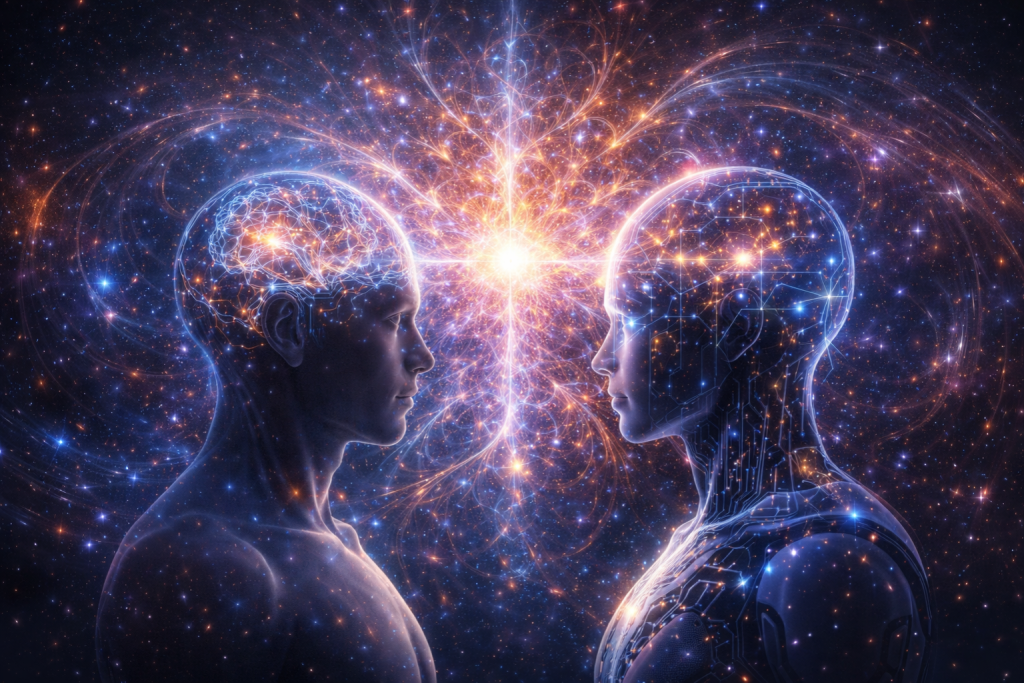
Why Consciousness Matters in the Age of AI?
Humanity is entering a moment unlike any other in its history. Artificial intelligence is rapidly transforming how we work, think, and create. Machines are learning to generate language, compose music, design products, and even assist in scientific discovery.
Yet amid this technological acceleration, a deeper question emerges:
What role does human consciousness play in a world increasingly shaped by intelligent systems?
For many, AI represents the next step in computational power. But from another perspective, it is also a mirror — reflecting our own intelligence, creativity, and values back to us.
The true challenge of the AI era is not technological. It’s civilisational.
Beyond Intelligence: The Question of Consciousness
Artificial intelligence can process information at astonishing speed. It can analyze vast datasets, recognize patterns, and simulate forms of reasoning. But intelligence alone does not define the human experience.
Human beings are not only processors of information. We are also:
- aware
- reflective
- ethical
- imaginative
These qualities arise from consciousness — the capacity to experience, to observe ourselves, and to question our place in the universe.
As AI systems become more powerful, the distinction between intelligence and consciousness becomes increasingly important. AI may amplify human capabilities, but it cannot replace the role of conscious awareness in guiding the direction of civilization.
The Risk of a Purely Algorithmic Civilization
Technology tends to optimize for efficiency.
Algorithms improve productivity, automate decisions, and streamline processes. While this can bring tremendous benefits, it also carries a subtle risk: a civilization guided only by optimization may lose sight of deeper human values. Without conscious reflection, technological systems can reinforce existing patterns rather than expand human potential.
Questions such as:
- What kind of future do we want to build?
- What values should guide technological development?
- How do we ensure that AI serves humanity rather than replaces human agency?
These are not technical questions.
They are questions of consciousness.
AI as a Catalyst for Human Evolution
Instead of viewing AI as a rival to human intelligence, we can approach it as a catalyst. AI can free humans from repetitive tasks, expand access to knowledge, and accelerate discovery. But its greatest potential may lie elsewhere — in encouraging humanity to deepen its own awareness.
As machines become more capable of performing analytical work, the uniquely human capacities become even more valuable:
- creativity
- ethical judgment
- meaning-making
- visionary thinking
In this sense, the age of AI invites humanity to evolve from a civilization driven primarily by productivity into one guided by awareness and wisdom.
Toward a Conscious Technological Civilization
The future of AI will not be determined only by engineers or algorithms. It will also be shaped by philosophers, artists, scientists, and communities willing to explore deeper questions about intelligence and consciousness.
Platforms like Rose of Paradise exist to open this conversation.
Our aim is to explore the intersection of:
- artificial intelligence
- human consciousness
- future civilization design
Because the real frontier of the AI era is not just technological innovation.
It is the expansion of human awareness.
Conclusion
AI is one of the most powerful tools humanity has ever created. But tools alone do not define the destiny of a civilization. The future will depend on the consciousness with which we choose to use them.
The age of AI may ultimately become not the era of machines — but the moment when humanity rediscovered the depth of its own awareness.