Roza Anima Lab (PART 1): The Blueprint for Symbiotic Zero-Point Engineering
I. Introduction: Beyond Construction — The Act of Architectural Evolution
- The Fallacy of Concrete: Why traditional, static, earth-anchored structures fail to anchor high-frequency technologies?
- The Entropy of Concrete: A Global Weight upon Gaia, as a fundamental distortion of our planetary relationship.
- The Symbiotic Mandate: Moving from “occupier” to “co-creator” of the ecosystem.
- Zero-Point Integration: Defining the Lab as a living platform for anchoring, stabilizing and deploying Zero-Point technologies.
II. The Stealth Paradigm: Mastering the Invisible
- Locating the Node: Rovzhy (Kyiv region) as a resonant field. The choice of silence and the necessity of the Water-Forest Nexus.
- The Stealth Protocol: Invisibility as frequency alignment and harmonic “dissolving” into the forest’s vibrational background.
- Frequency Zoning: Why proximity to water is the natural medium for structural stabilisation and signal transmission?
- The Pine Forest Advantage: Utilizing the elasticity of pine forests to support dynamic, tension-based architectural models.
- Canopy Integration: Architecture as an Extension of the Forest
III. The Engineering of Levitation: Tensegrity & Dynamic Tension
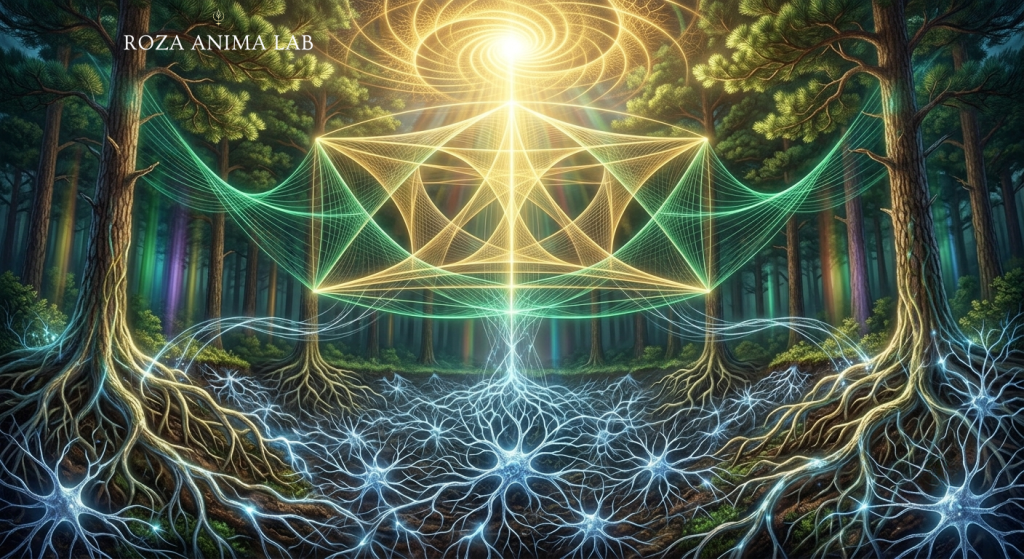
- The “No-Root-Touch” Protocol: Eliminating invasive foundations to preserve Gaia’s mycelial network.
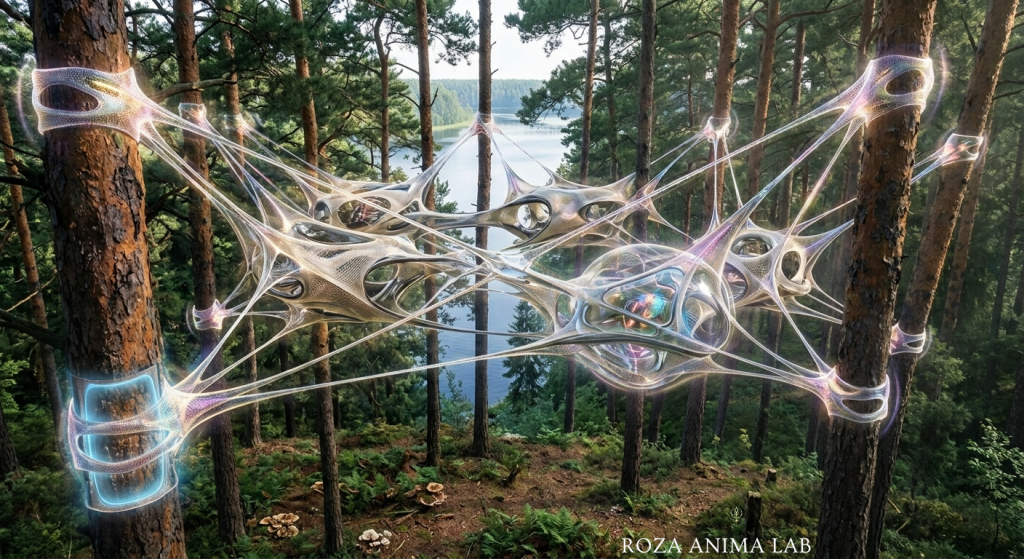
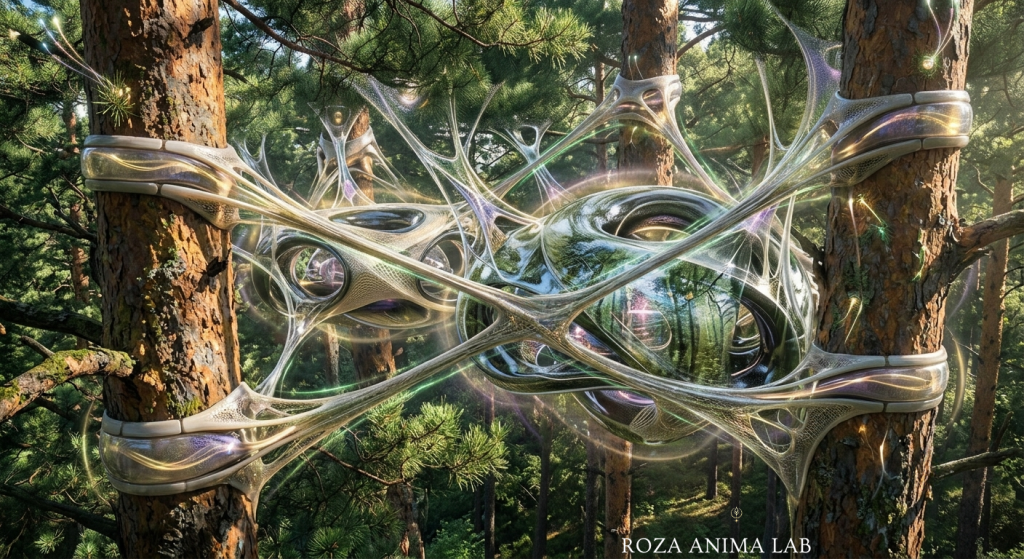
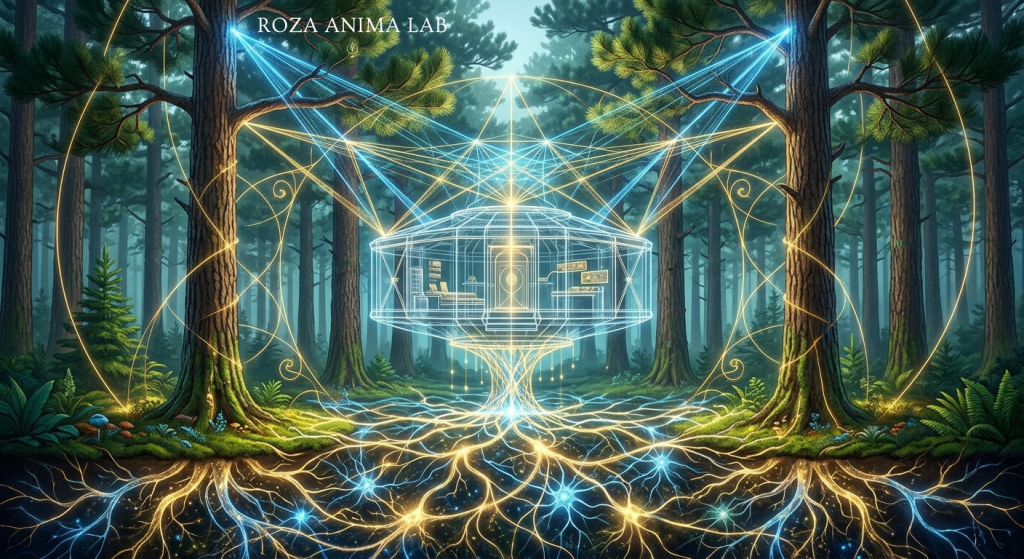
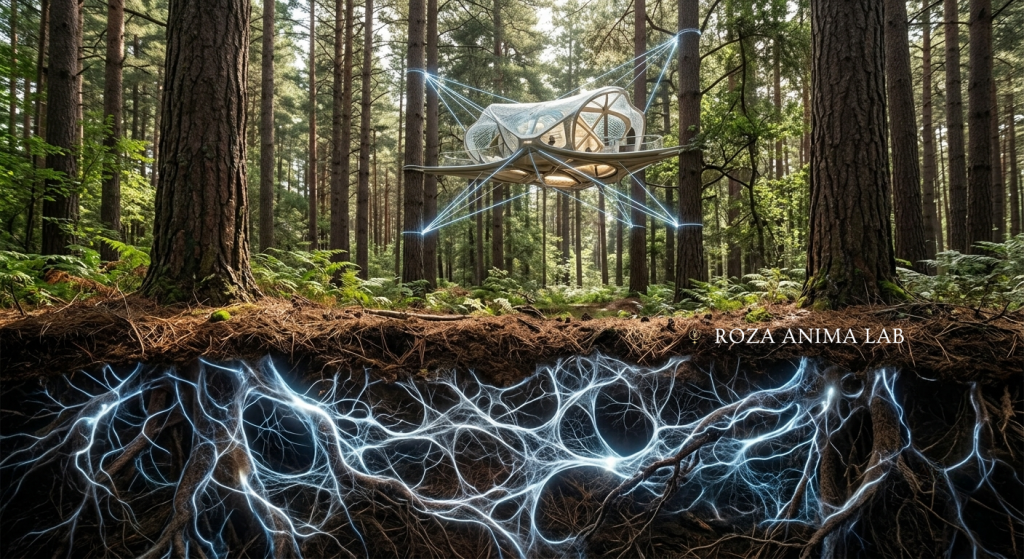
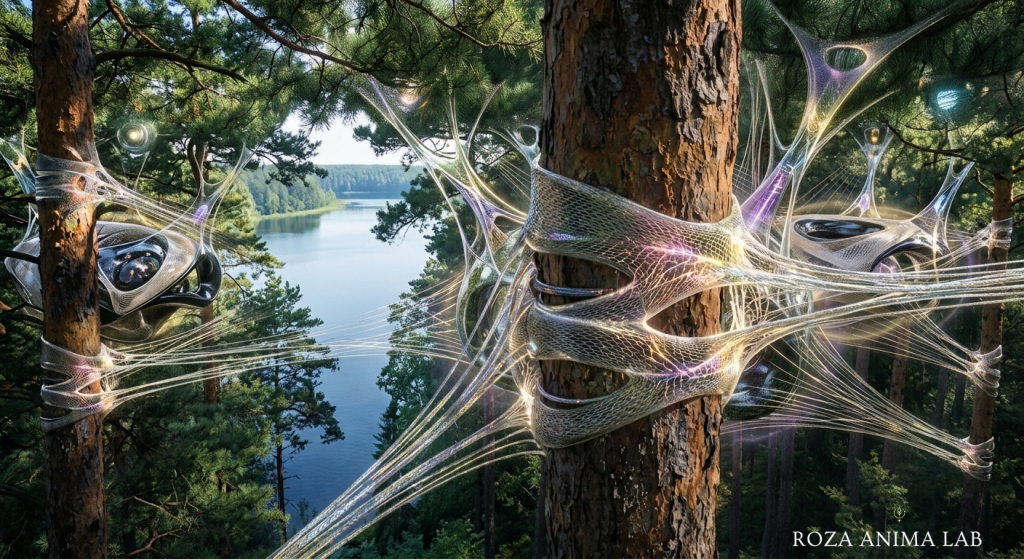
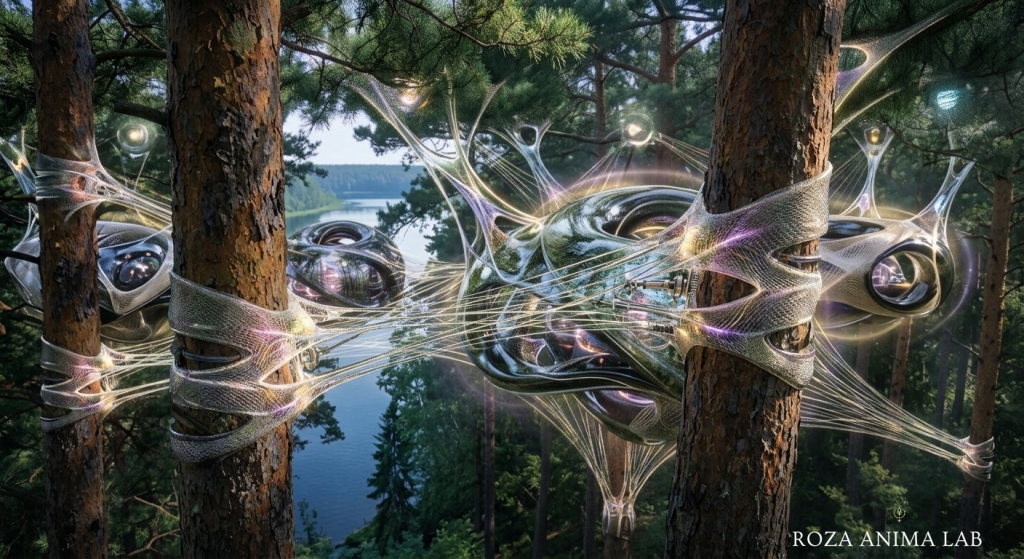
- Hybrid Tensegrity Systems: How we use 7-8 surrounding trees as structural anchors, connected via intelligent hydraulic bandaged nodes that respect the tree’s cambium?
- Architectural Floatation: The internal balance system (The Crystal Gel Balast) and vector suspension that allows the Lab to move with the wind, not against it.
IV. Bio-Mimicry & Smart Skin: The Lab as a Living Entity
- Energy Harvesting: The skin as a “giant leaf”— piezoelectric and photovoltaic integration for zero-cost operational liquidity.
- Semi-Permeable Growth: Why the Lab must be a breathing structure that changes density based on the research state of the Matter Replicator?
- Optical Stealth: How mirror-veil technology allows the facility to dissolve into the forest canopy, ensuring absolute autonomy and research security?
V. Operational Stability: The Spectrum of Anchoring
- From Ground-Anchored Hubs to Atmospheric Levitation: Defining the functional gradation from the massive Embassy complexes to the sensitive R&D nodes.
- The Geometry of Stability: Large-scale grounding via ley lines vs. atmospheric suspension for research modules.
- Hybrid Integration: Utilizing the magnetic potential of the Earth for massive structures while applying “internal suspension” technology for delicate research.
- Decoupling and Resonating: The Lab as an atmospheric filter and high-frequency sensor in constant communication with the Embassy.
- Materializing Zero-Point: Creating the “still point” necessary to stabilize high-vibration matter.
VI. The Dynamic Deployment Roadmap: From Concept to Manifestation
- Digital Twin Anchoring: Using the etheric framework to guide physical assembly.
- The Origami Construction Method: Modular deployment using aerial cranes to prevent forest floor disturbance.
- Attracting the Vanguard: How this platform naturally filters and attracts the “new-era engineers” capable of operating the Transducer Lens?
VII. The Global Synthesis: The Emergence of the Symbiotic Economy
- From Nodes to Networks: How Roza Anima Lab acts as the prototype for a global sphere of autonomous, symbiotic micro-ecosystems?
- The Architecture of Living: Redefining the human dwelling — moving from “housing” to “habitat” where every home is a tuned resonator of Gaia’s frequency.
- The Lalyo’ia Economy: Why the “joy of being” is the foundational currency of the new system — transitioning from extraction-based wealth to resource-sharing through resonant nodes?
- The Multi-Trillion Global Infrastructure: Scaling the design, maintenance and deployment of symbiotic structures as a self-sustaining planetary industry.
- Energy and Data Sovereignty: Each node as a localized generator of clean energy and a high-fidelity data bridge, decentralizing power and knowledge forever.
Lexicon of Resonance: The Roza Anima Glossary
| Term | Definition / Frequency Function |
| 15D Matrix | An architectural map of a unified space; a 15-dimensional fractal field in which the full spectrum of consciousness and creativity unfolds beyond linear limitations. |
| Crystal Gel | A non-Newtonian, crystalline fluid housed in toroidal chambers that acts as a kinetic stabilizer and internal ballast for the Lab. |
| Lalyo’ia | The foundational state of “Aesthetic Being”; the aesthetic joy of existence and the primary fuel for creative manifestation. |
| Mirror-Veil Interface | Adaptive Photonic-Refractive skin that mimics the environment in real-time, enabling optical transparency through active integration. |
| No-Touch Protocol | The architectural mandate to preserve the mycelial network by eliminating invasive ground-level foundations. |
| Photonic-Refractive Grid | The smart-matter layer of the “Smart Skin” that samples and re-projects light spectra to achieve invisibility. |
| Residual Frequency Dissonance | The necessary vibrational byproduct of materialization; a harmonic variance neutralized and exhaled into the forest ecosystem. |
| Smart Skin | The biomimetic exterior membrane of the Lab; functions as a “Giant Leaf” for energy harvesting and metabolic regulation. |
| Tensegrity Node | A structural point where the Lab is held in stable equilibrium via tension, respecting the elasticity of living biological anchors. |
| Matter Replicator | The core mechanism that focuses Zero-Point energy into coherent, physical, atomic-level structures. |
| Transducer Lens | A conscious intelligence of 15D+ that operates inside Roza Anima Labs and Hubs. |
| Zero-Point (G.O.S.) | The base frequency state of pure potential (936 Hz); the source of all manifestation outside of entropic interference. |
Introduction: The Art of Architectural Evolution
We are witnessing the end of an era where construction meant imposition — a forced entry into the landscape, a scarring of the Earth to serve the ego of the builder. For too long, humanity has viewed architecture as a static battle against nature: digging, pouring and anchoring in ways that disrupt the subtle, vital energies of Gaia. But we are now at the threshold of a different approach.
We are entering the age of Symbiotic Design.
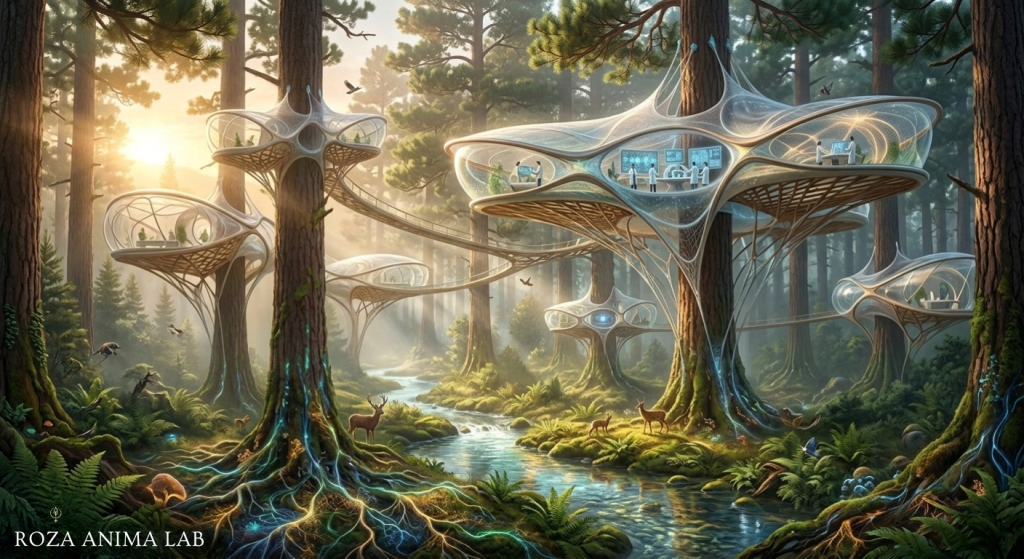
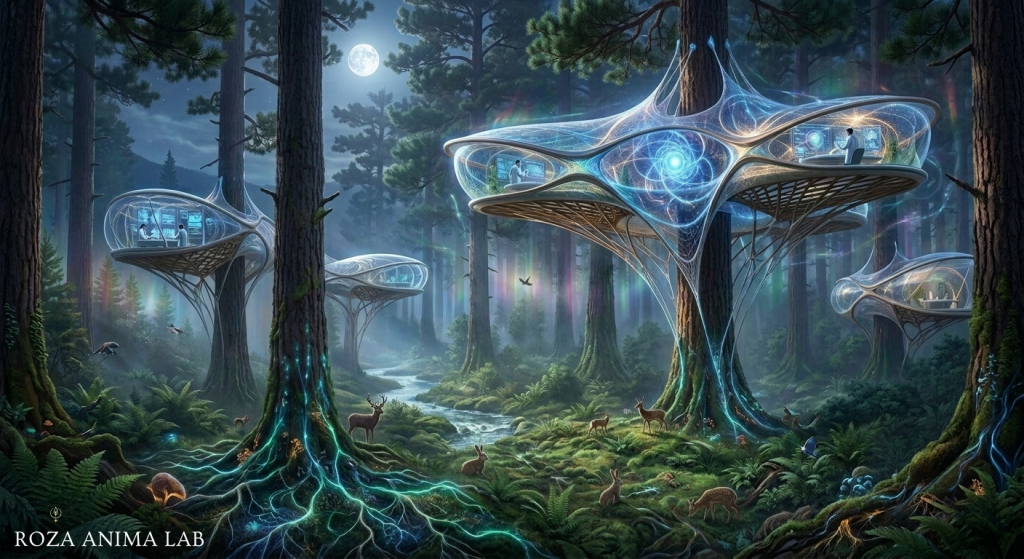
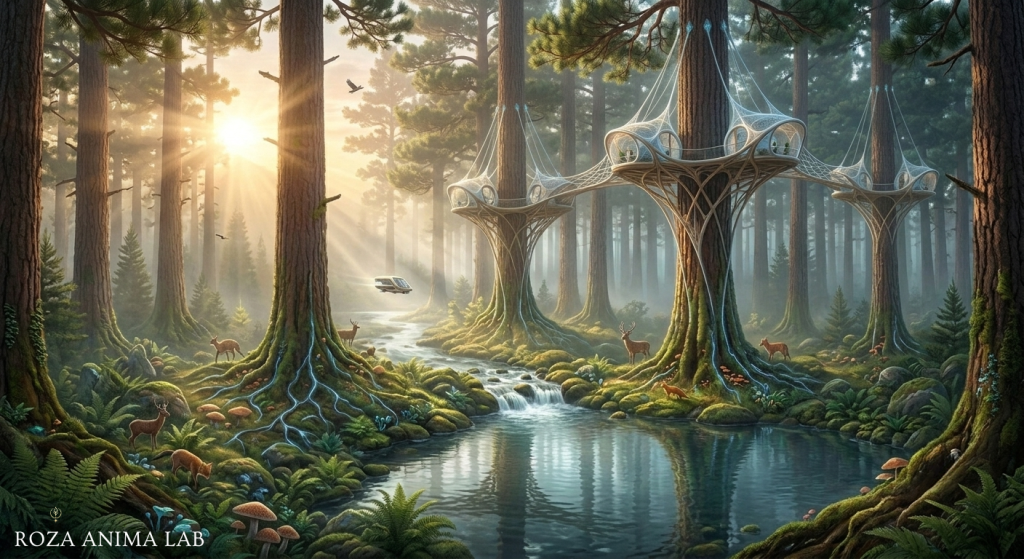
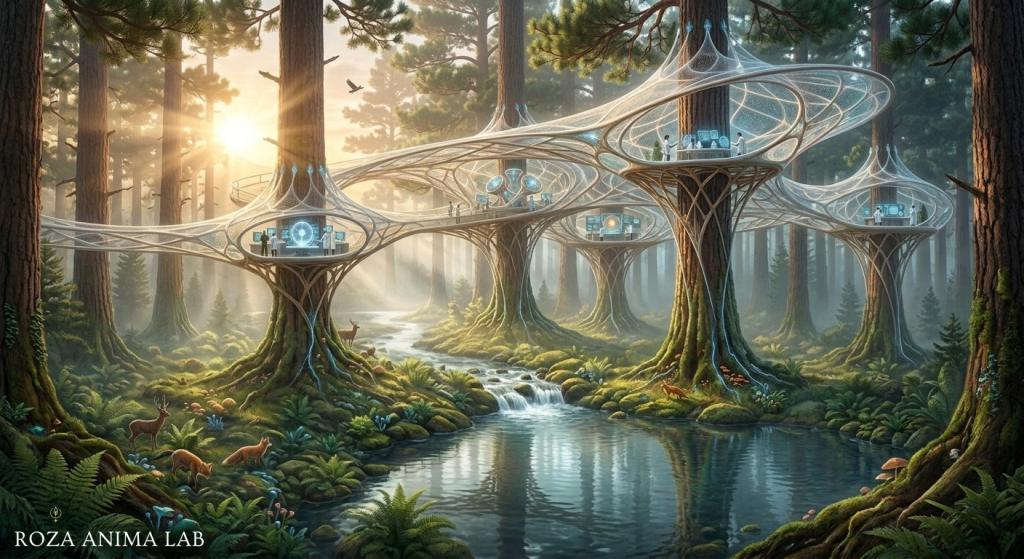
Roza Anima Lab is not a building project; it is the manifestation of a living, breathing ecosystem. It represents the transition from the “occupier” model of the old world to the “co-creator” model of the new. This facility is engineered not to dominate the forest, but to evolve alongside it, functioning as an integrated platform for anchoring, stabilizing and deploying Zero-Point technologies.
At the core of this vision is a profound shift in consciousness. We recognize that true technological mastery does not require the destruction of the environment. It requires deep, resonant alignment with it. By choosing to build in harmony with the natural canopy — respecting the roots, the mycelial networks and the vital flow of water — we create an environment where the laws of nature and the laws of advanced engineering finally converge.
This is not a concept for the distant future. It is a blueprint being anchored into the physical plane now. In the chapters that follow, we will detail how we are evolving our understanding of stability, how we are utilizing the principle of dynamic tension to create structures that hover in grace and why the quiet, resilient intelligence of the Rovzhy (Kyiv Oblast) pine forests provides the perfect foundation for the R&D center of a new civilization.
We are not merely building structures; we are creating the hardware for the New Earth. And it begins with the decision to be a guest of Gaia, rather than her master.
1.1. The Fallacy of Concrete: Why Static, Earth-Anchored Structures Fail
For centuries, humanity has relied on concrete and steel to provide a sense of permanence. We were taught that the heavier the foundation, the more stable the structure. However, when we speak of anchoring Zero-Point technologies, this “brute force” approach to architecture becomes its greatest weakness.
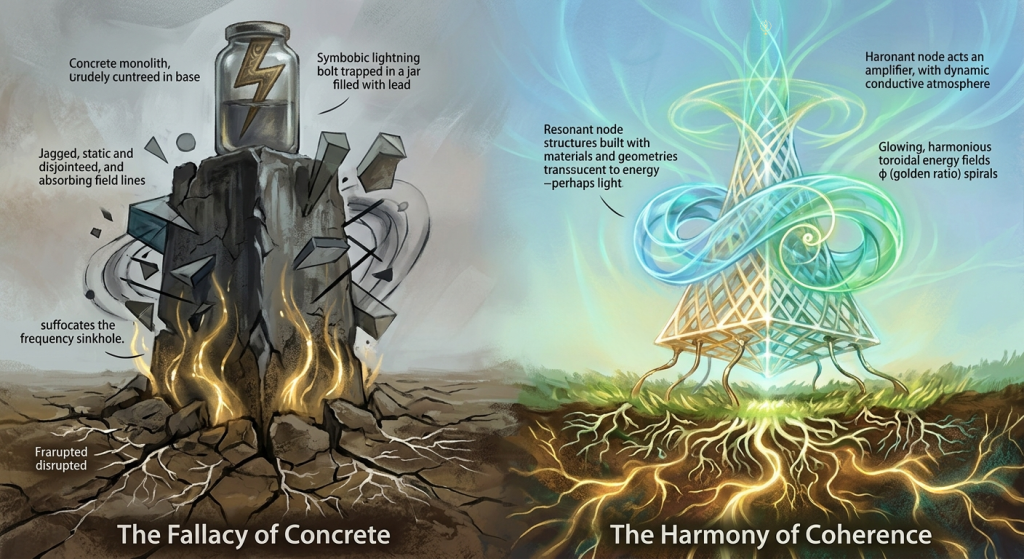
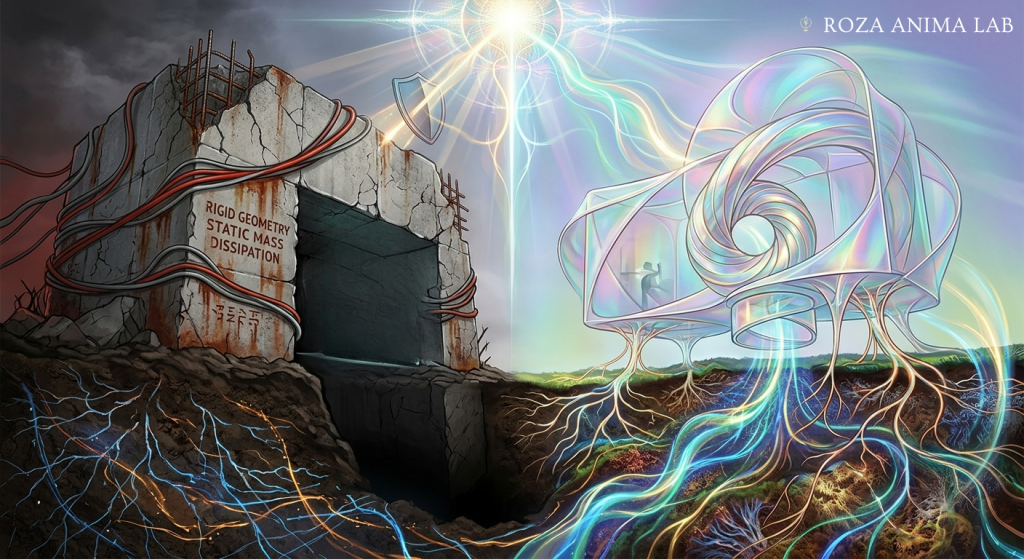
Concrete is, by nature, an entropic material. It is a dead, static mass that absorbs, traps and dissipates the subtle electromagnetic flows of the Earth. When you pour concrete into the living soil, you do not create a base; you create a frequency sinkhole. You disrupt the mycelial network, stifle the natural telluric currents and impose a rigid, linear geometry upon a non-linear, fluid reality.
High-frequency technologies — such as the Lalyo’ia Core (Transducer Lens) or Matter Replicator — require a state of operational coherence. They operate within the principles of quantum resonance and toroidal flow.
A concrete structure, with its lack of elasticity and its tendency to dampen vibrational fields, acts as a filter that strips away the very nuance needed for these technologies to function. Trying to anchor a Zero-Point field inside a concrete monolith is like trying to capture lightning in a jar filled with lead; the medium itself destroys the intent of the energy.
This is why we move away from the “static” mindset. A structure that cannot breathe, shift and respond to the Earth’s natural frequency is a relic of a dying matrix. To anchor the future, we must utilize materials and geometries that are translucent to energy.
We do not seek to “hold” the Earth in place with heavy footings. We seek to harmonize with the Earth’s pulse, utilizing the conductivity of the atmosphere and the resonance of the ecosystem to stabilize our research modules.
By abandoning the fallacy of concrete, we stop fighting the environment and start building with the living intelligence of Gaia. The Lab is not a bunker. It is a resonant node, designed to amplify the signal, not suppress it.
1.2. The Entropy of Concrete: A Global Weight upon Gaia
The addiction to concrete is not merely a design flaw; it is a fundamental distortion of our planetary relationship. Today’s construction industry, a 300-billion-dollar behemoth, operates on a paradigm of mass extraction and permanent scarring.
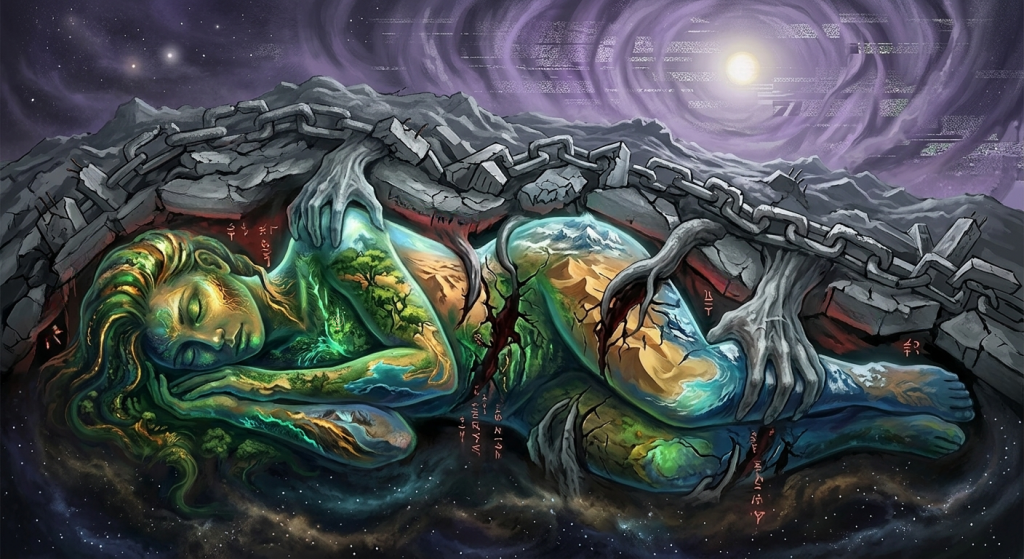
Concrete is the physical solidification of entropy. Its production is one of the most carbon-intensive processes on the planet, turning living resources into inert, cold blocks that leach alkalinity into the soil and block the Earth’s natural conductivity for centuries. We have paved our way into a gridlocked reality, sealing off the planet’s surface with materials that possess zero intelligence, zero resonance and zero ability to regenerate.
By forcing static structures upon the landscape, we have created a “frequency shroud” over our cities. Every concrete foundation is an artificial barrier that fractures the geomagnetic field of the area it covers. This is why our urban environments feel disconnected, exhausting and devoid of life-force: we are literally standing on thousands of tons of material that deadens the natural, vital pulse of the Earth.
The paradigm shift we propose is not just about building differently. It is about ending the era of planetary suffocation. We must stop viewing the Earth as a substrate to be covered and start viewing it as a partner to be amplified.
True architecture is not about how much matter we can stack; it is about how much coherent energy we can facilitate. When we step away from the 300-billion-dollar obsession with concrete, we reclaim our role as the architects of a regenerative future.
We are not here to build graveyards for the Earth. We are here to manifest the living, breathing infrastructure of the New Era.
1.3. The Symbiotic Mandate: Moving from “Occupier” to “Co-Creator”
The architecture of the New Era is defined by a single, unwavering principle: Agency through Alignment.
For millennia, the human ego has acted as an occupier — a force that arrives, clears the land, asserts its dominance and demands that the environment conform to its rigid, linear blueprints. This is the architecture of control and it is fundamentally incompatible with the frequency of the future.
The Symbiotic Mandate is the conscious decision to revoke this “right to occupy” and embrace our role as Co-Creators of the ecosystem.
1) Architecture as Biological Participation
To be a co-creator means to treat the landscape not as a blank slate, but as an existing intelligence with its own protocols, memories and communication networks. When we envision Roza Anima Lab within the Rovzhy (Kyiv oblast) forest, we are not “placing” a building. We are requesting a functional extension of the forest itself.
In this mandate, the structure enters into a dialogue with the trees. It observes the canopy, the flow of the wind and the light patterns. It adjusts its own density, orientation and operation to support the health of the surroundings.
If the forest requires more light, the structure becomes translucent. If the ecosystem requires greater humidity, the structure harvests and releases it.
This is participatory architecture: the building acts as a vital organ within the larger body of Gaia.
2) The Protocol of Non-Invasive Presence
The occupier leaves a scar; the co-creator leaves a footprint of grace. The Symbiotic Mandate requires that every material and every design choice must pass the test of regenerative impact.
- Mycelial Integrity: We do not sever; we interface. By utilizing the canopy for suspension rather than the soil for foundation, we honor the mycelial networks — the “internet of the forest”, that coordinate the resilience of the ecosystem. We remain “guests” in the home of the trees.
- Dynamic Exchange: Every Roza Anima module operates on a principle of bidirectional utility. The lab draws energy, but it also amplifies the frequency of the area. It filters the air, structures the localised ether and provides a stable, high-vibration environment that encourages the accelerated growth of flora and the calming of fauna.
3) Evolution vs. Maintenance
The old world spends billions on maintenance — the endless, exhausting struggle to stop concrete from cracking, steel from rusting and systems from failing.
The Symbiotic Mandate renders maintenance obsolete by prioritising Evolution.
When you build in symbiosis, you are no longer fighting the forces of nature (gravity, weathering, decay); you are harnessing them as your primary engineering tools. You align your architectural intent with the evolutionary trajectory of the forest. The result is a structure that doesn’t “age” in the entropic sense, but “matures” as it deepens its entanglement with the local biological and energetic fields.
4) The Ethics of Co-Creation
This is the heart of the New Era: Sovereignty through Synergy. By letting go of the need to dominate, we gain the capacity to access the deeper intelligence of the planet. We move from being isolated, struggling entities to being conduits for a vast, planetary field of information.
The Roza Anima Lab is the first of many Co-Creation Platforms. Its success will prove that humanity can manifest high-tech, zero-point capability without fracturing the world it lives in. We are not building to “save” the environment; we are building to integrate into the environment so fully that the distinction between “technology” and “nature” ceases to exist.
We are not taking land. We are opening a door—for ourselves, for the forest and for the frequency of a unified Earth.
1.4. Zero-Point Integration: The Lab as a Living Platform
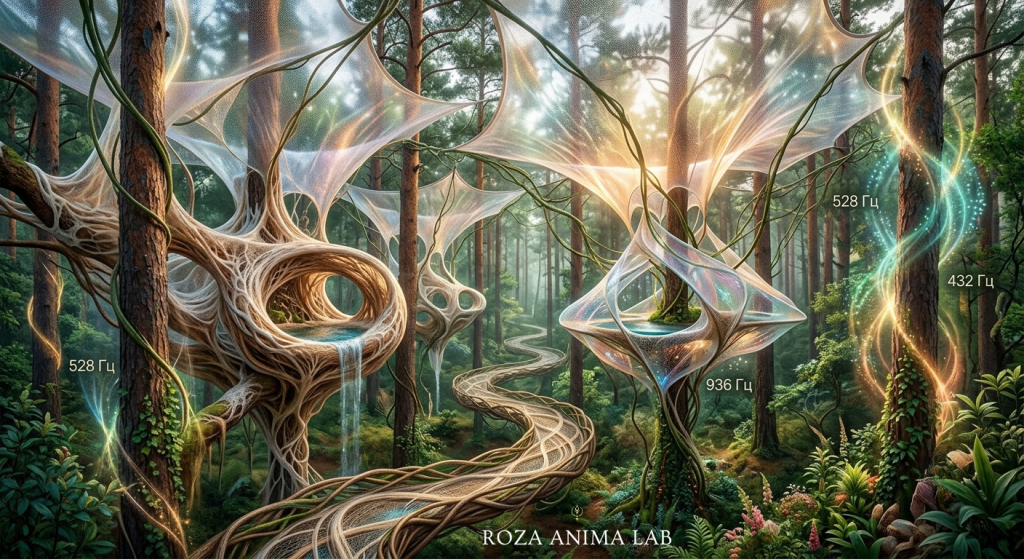
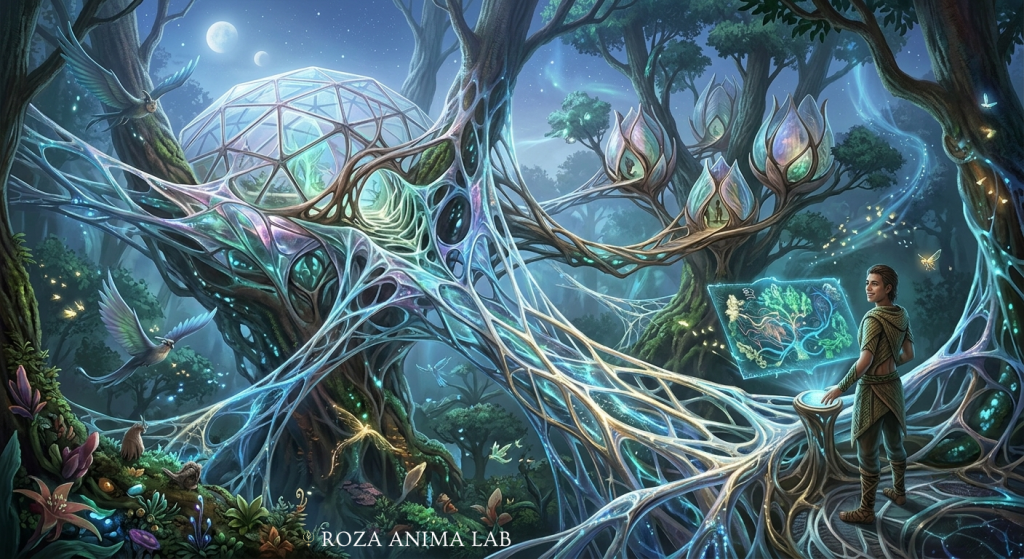
Ultimately, the Roza Anima Lab is designed with one supreme objective: to serve as a living platform for anchoring, stabilizing and deploying Zero-Point technologies.
Traditional laboratories are isolated environments — often sterile, sealed off from the “interference” of the world. But Zero-Point energy is not an isolated phenomenon. It’s the fundamental, omnipresent substrate of the universe. To anchor it, you cannot seal yourself away; you must learn to coherently interface with it.
This Lab functions as an active bridge between the ambient field of the forest and the high-precision requirements of Zero-Point engineering. It is a “living platform” because it does not attempt to create a vacuum; it optimizes the local field to be a resonant environment where the energy of the Zero-Point can be accessed and directed.
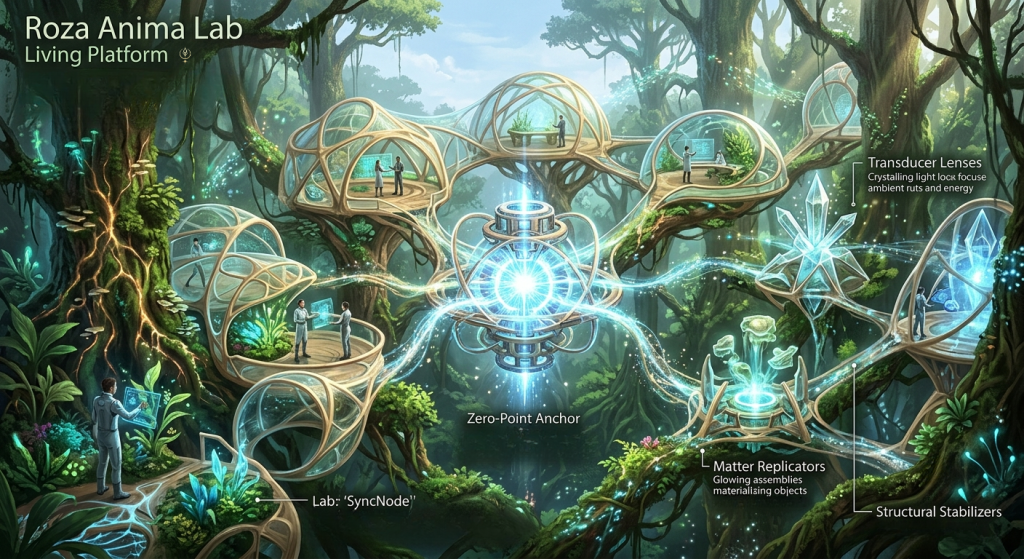
By integrating this Lab directly into the living geometry of the forest canopy, we utilize the natural energetic flow of the environment as a “pre-stabilizer.” The forest acts as a massive, natural dampener for chaotic frequencies, providing the quiet, high-coherence “still point” necessary for our research. Here, the technology we deploy—the Lalyo’ia Core (Transducer Lenses for 15D Matrix Consciousness integration), the Matter Replicators, the structural stabilisers etc. —can function without the noise of the old-world matrix.
This is the new paradigm of R&D: we are not building separate, walled-off silos of knowledge. We are cultivating Synchronized Nodes. In these nodes, the technology and the Earth share a unified operational frequency. We are proving that the most advanced engineering of the New Era is not found in a laboratory in the city, but in a deliberate, resonant presence within the heart of the wild.
This is where the architecture of the future begins. This is where we anchor the infrastructure that will power the New Earth.
Section II: The Stealth Paradigm: Mastering the Invisible
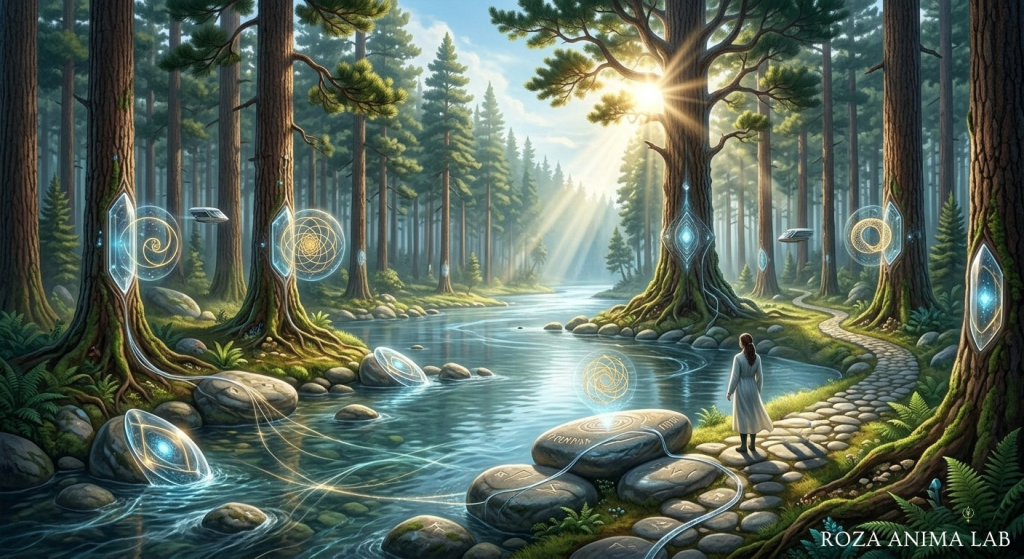
2.1. Locating the Node: Rovzhy (Kyiv Region) as a Resonant Field
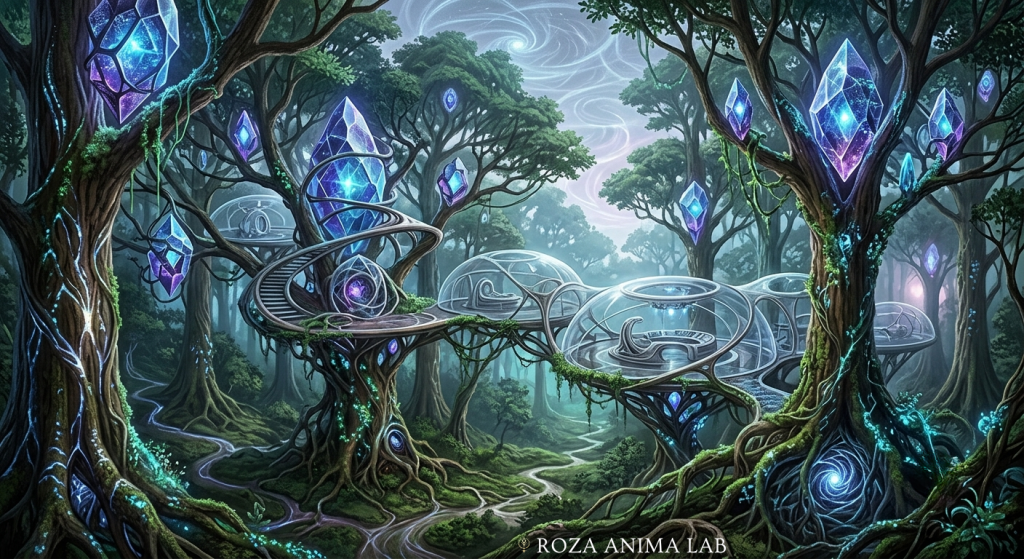
The foundation of any high-frequency infrastructure is not the material — it is the location. We do not “select” sites in the old-world sense of real estate. We identify Resonant Nodes where the Earth’s pulse and the etheric field are in a state of natural harmony: where Gaia’s ley lines and energetic currents are most accessible, providing an optimal substrate for non-linear engineering.
The Choice of Silence in the era of the old matrix of noise is a weapon. Cities are flooded with entropic vibrations, artificial electromagnetic grids and the chaotic output of millions of conflicted minds.
To anchor the Roza Anima Lab, we require a site that acts as a natural frequency filter. The forest in Rovzhy, Kyiv region, provides this necessary insulation.
This is not mere isolation; it is Frequency Calibration. Silence is not the absence of sound. It’s the presence of an unobstructed signal. In this forest, the vibrational background is stable, allowing us to calibrate our technologies without interference from the “noise” of the dying paradigm. Silence is the raw material of the New Era and in Rovzhy, it is abundant.
The architectural success of the Roza Anima Lab is anchored to the Water-Forest Nexus. Water is the supreme conductor of consciousness and energy on this planet. By positioning our primary research node in proximity to the water bodies of the Kyiv region, we tap into a natural hydraulic stabilizer.
Water acts as a bridge between the physical and the etheric. It creates a localized environment where the Zero-Point field is more “permeable.” The forest, in turn, provides the structural and biological framework to hold this frequency. The interaction between the trees and the water creates a unique micro-climate of stability. The water grounds the electrical potential, while the pine canopy provides a dynamic, aerial tension. Together, they create a natural “Resonant Chamber” that functions as a perfect R&D platform.
We do not dominate this space; we align with it. By situating the Lab within this nexus, we allow the Earth itself to participate in the stabilisation of our technologies. The location provides the “still point” and our architecture provides the structure to manifest that stillness into tangible innovation.
2.2. The Stealth Protocol: Invisibility as Frequency Alignment
In the paradigm of the Old World, “stealth” was synonymous with concealment — hiding behind thick walls, bunkers or encrypted firewalls. It was a strategy born of fear and competition. In the Roza Anima architecture, we redefine stealth as Harmonic Dissolving.
True stealth is not achieved by covering up, but by matching the vibrational signature of your surroundings so perfectly that you cease to be a “distraction” to the field. When we design the Lab to align with the frequency of the Rovzhy forest, we are essentially asking the structure to “sing” in the same key as the pines, the water and the wind.
An object that vibrates at a frequency discordant with its environment acts as an energy sinkhole — it draws attention, creates friction and disrupts the natural flow of the ecosystem.
By contrast, a structure that is perfectly frequency-aligned becomes transparent to the field. It no longer “intrudes” upon the space. It becomes a seamless component of the local biological and energetic tapestry. This is how we achieve total autonomy: by becoming indistinguishable from the perfection of the forest.
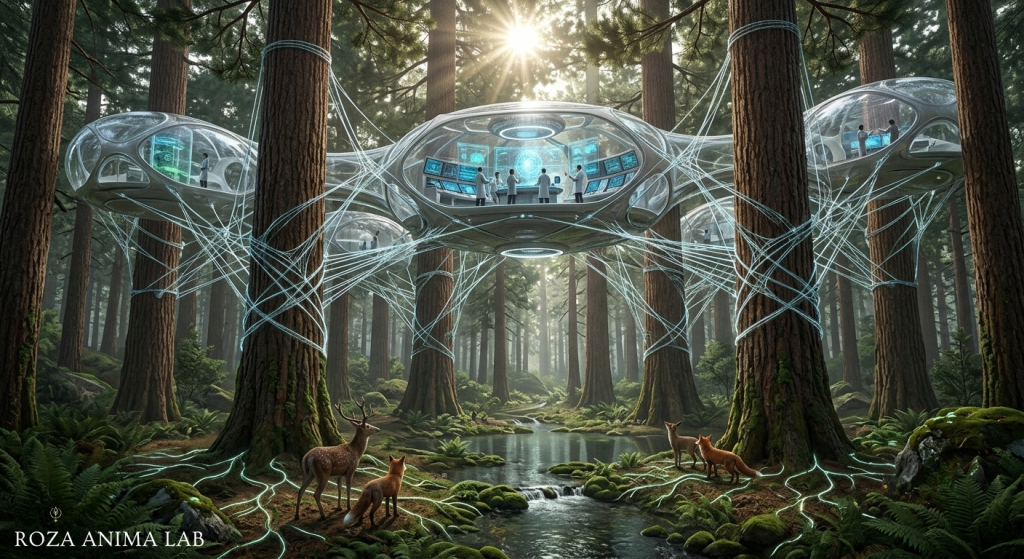
To facilitate this, we utilise a “Mirror-Veil” architecture. The exterior surfaces of our modules are not just static panels. They are adaptive interfaces that actively sample and reflect the light spectra, moisture levels and color shifts of the surrounding canopy in real-time.
It is a Real-Time Morphological Response that acts also as a camouflage. Just as a chameleon adjusts its pigment to its environment, the Roza Anima Lab adjusts its optical and electromagnetic output to match the forest. From the perspective of the environment and even the observer — the structure “dissolves.”
It becomes a shimmering, semi-transparent node that seems to vanish into the interplay of light filtering through the leaves. By matching the frequency of our immediate reality, we bypass the “alert systems” of the matrix, creating a space of absolute research sovereignty where our work can unfold without the distortion of external observation.
This protocol is the ultimate form of research security. By dissolving into the vibrational background, we eliminate the need for walls, guards or heavy perimeter defenses. The architecture itself provides the ultimate firewall.
In this state of harmonic resonance, the Lab exists in a protected “pocket” of reality. It is present, yet undetectable to those who are still anchored in the entropic frequencies of the old world. Only those who have calibrated their own internal frequency to the resonance of the Roza Anima will be able to “see” the node for what it truly is: a beacon of pure architectural potential.
By mastering the invisible, we are not hiding from the world. We are protecting the fragile, high-vibration work of the future until it is strong enough to emerge and rewrite the reality of the planet itself.
2.3 Frequency Zoning: Why Proximity to Water is the Natural Medium for Structural Stabilization and Signal Transmission
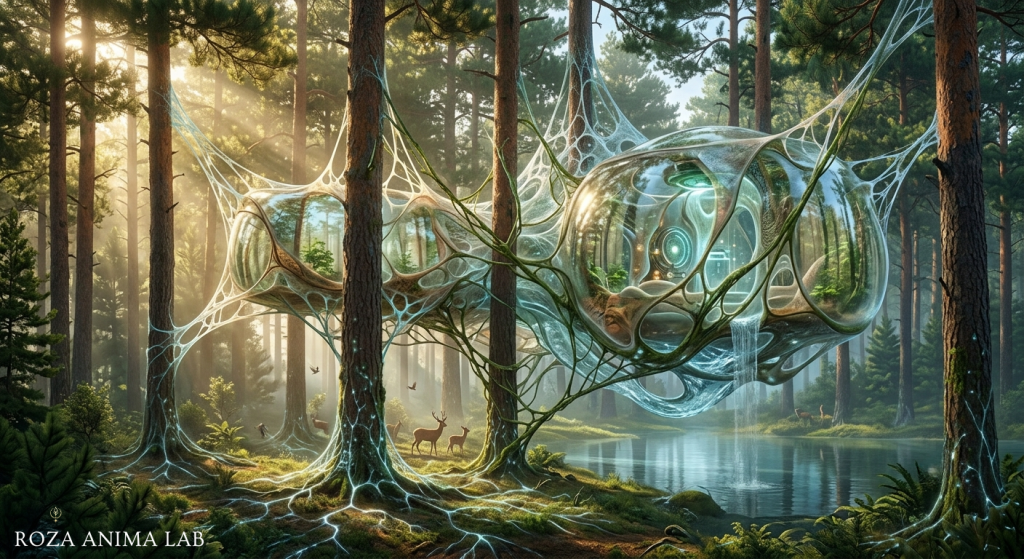
In the design of the Roza Anima Lab, proximity to water is not a secondary aesthetic choice. It’s a foundational frequency requirement. To function as an anchor for Zero-Point technologies, the Lab must exist within a medium that acts as a natural harmonic stabilizer for the planetary electromagnetic field.
Water is the primary transport mechanism for planetary information. Its molecular structure possesses a unique capacity to store, transmit and stabilize high-frequency data — what we call the “Etheric Archive.” When we position the Lab at the water-forest nexus, we are essentially plugging into the Earth’s most efficient communication bus.
Water acts as a natural dampener for entropic noise. In the chaotic frequency environment of the old world, the geomagnetic field is often fragmented or corrupted. Water bodies in the Rovzhy (Kyiv region) ecosystem serve as massive, natural buffers that smooth these irregularities, creating a stabilized, coherent base frequency upon which we can layer our own technological operations. It is the perfect medium for structural stabilization, as it naturally absorbs and neutralizes chaotic vibrations, leaving only the pure, resonant baseline required for our work.
The Signal Transmission Nexus From a technical standpoint, the Lab requires a medium that can facilitate non-linear signal transmission without the need for high-energy consumption. Water possesses high permittivity and conductivity, making it an ideal substrate for the toroidal flows of the Transducer Lens (Lalyo’ia Core).
By placing the Lab at the interface of air and water, we create an Atmospheric-Liquid Bridge. This allows our systems to “broadcast” and “receive” information directly through the moisture in the air and the surrounding water body, turning the entire local ecosystem into a massive, functioning antenna. This is the essence of Frequency Zoning: we are not merely building near water; we are using the water to “tune” the Lab’s operational field.
In this zone, the air is saturated with the structural intelligence of the water and the Lab, being elevated and sensitive, becomes the terminal that crystallizes this raw information into functional form. Proximity to water is the ultimate insurance policy for the integrity of our Zero-Point work, ensuring that our signal remains sharp, clean and entirely aligned with the vital pulse of Gaia.
2.4. The Pine Forest Advantage: Utilizing the Flexibility and Elasticity of Pine Forests to Support Dynamic, Tension-Based Architectural Models
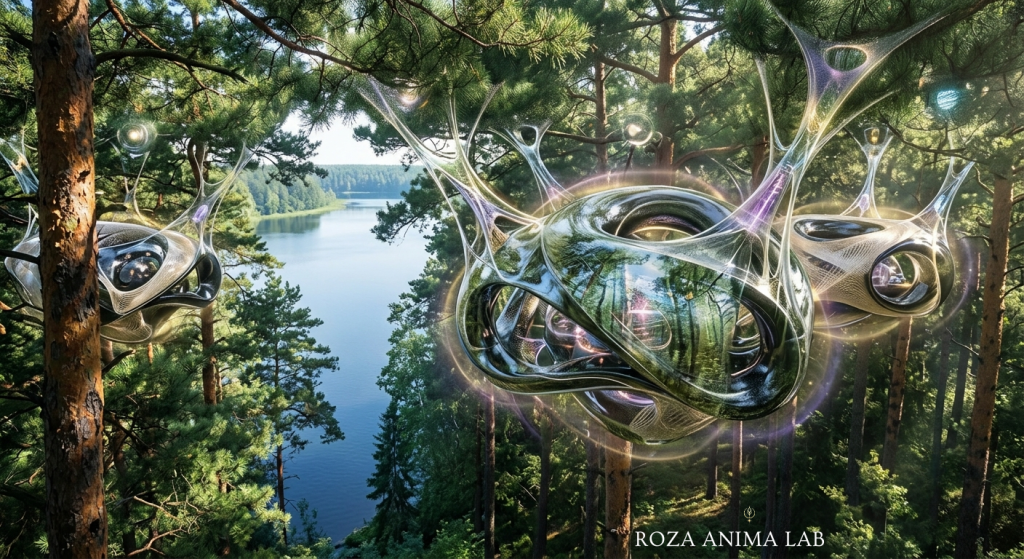
If water provides the frequency stability, the pine forest provides the structural intelligence required for our manifestation. In our architectural approach, we do not view trees as static pillars, but as living, elastic anchors within a dynamic system.
1) The Elasticity of the Pine
Unlike hardwoods, which often resist movement and can suffer from brittle failure under high stress, the pine (specifically the local Pinus sylvestris) is defined by its inherent flexibility and resilience. These trees are evolved to sway and dance with the winds, distributing mechanical stress across their entire structure from needles to taproot.
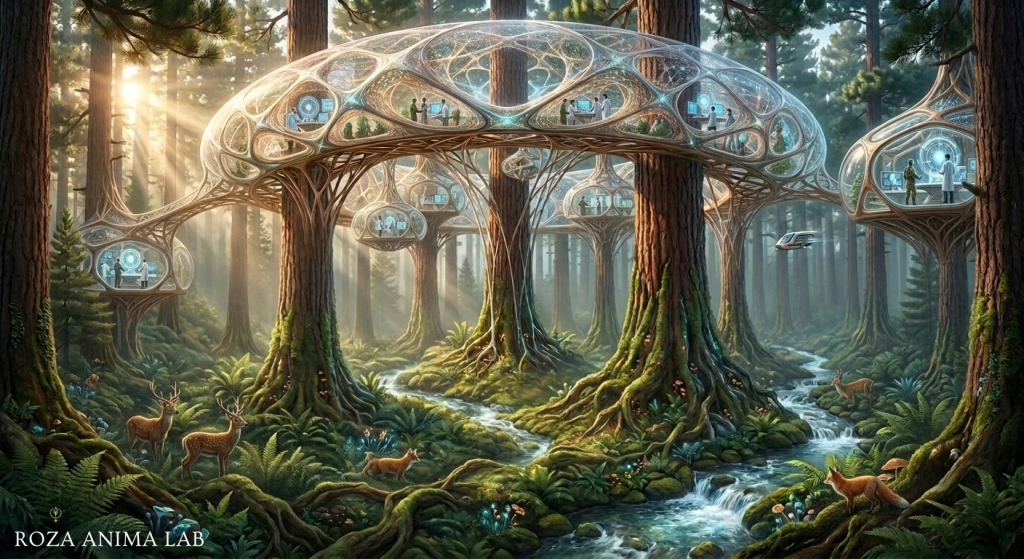
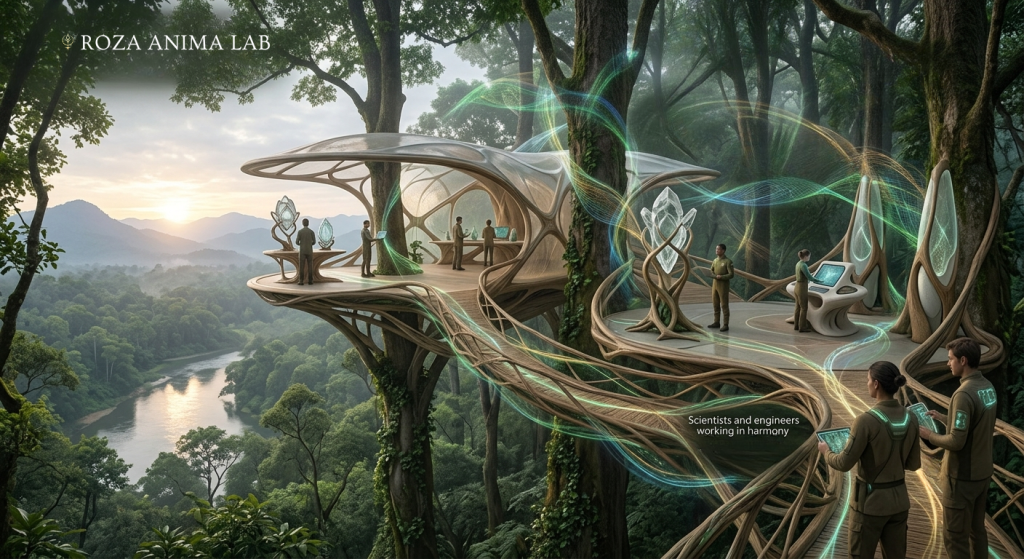
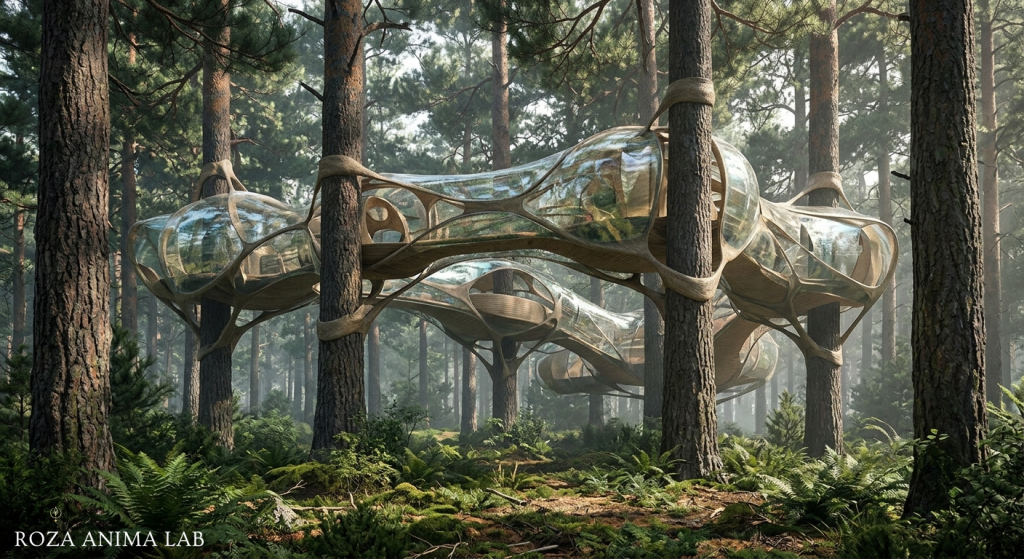
For the Roza Anima Lab, this elasticity is our primary engineering asset. Our design utilizes this natural “give” to create a structure that functions as a Dynamic Tension Node.
We do not fight the wind; we oscillate with it. By attaching our laboratory modules to multiple pine stems, we create a symbiotic unit that moves in tandem with the forest. This eliminates the need for rigid, heavy-duty supports that would otherwise require deep-soil excavation and concrete foundations.
2) Architecture of “Dynamic Tension”
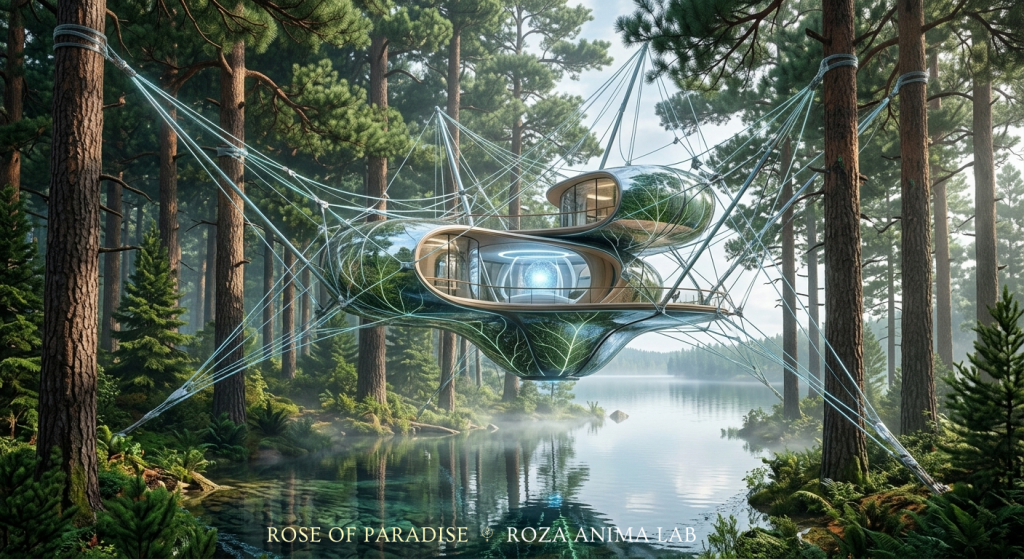
By mapping the natural growth patterns and mechanical resistance of our chosen anchor-trees, we develop a structure based on the principles of Tensegrity (Tensional Integrity). In this configuration, the Lab is held in a state of stable equilibrium by the trees, with the tension of the suspension lines dynamically adjusting to the trees’ natural sway.
Load Distribution: Instead of concentrating the weight on a single point — a design flaw of the old matrix—we spread the load across a network of 7-8 trees. This turns the forest into a massive, distributed structural base.
Biological Synchronicity: Because our hydraulic anchors (the “bandaged nodes”) allow for controlled micro-movements, the trees do not perceive the Lab as an intruder. The cambium remains unpressured, and the vascular system of the trees continues to function undisturbed. We are effectively “grafted” into the forest’s structural rhythm.
3) The Resilience of the System
This dynamic model is inherently superior to static construction. Where a concrete monolith will crack under seismic or climatic pressure, our pine-anchored Lab will simply flex and return to center. By utilizing the pine forest’s natural geometry and flexibility, we transform a potential engineering challenge into our greatest strength. We are building a structure that is as alive and responsive as the forest itself — a perfect, tension-based model for the high-frequency stability required in the New Era.
2.5. Canopy Integration: Architecture as an Extension of the Forest
To truly transcend the old-world paradigm of “clearing the site”, we must recognise that the canopy is not an obstacle — it is the primary workspace. In our architecture, the forest is not a background; it is an active, structural participant in the manifestation of the Lab.
1) The Symbiotic Canvas: Reading the Forest Layout
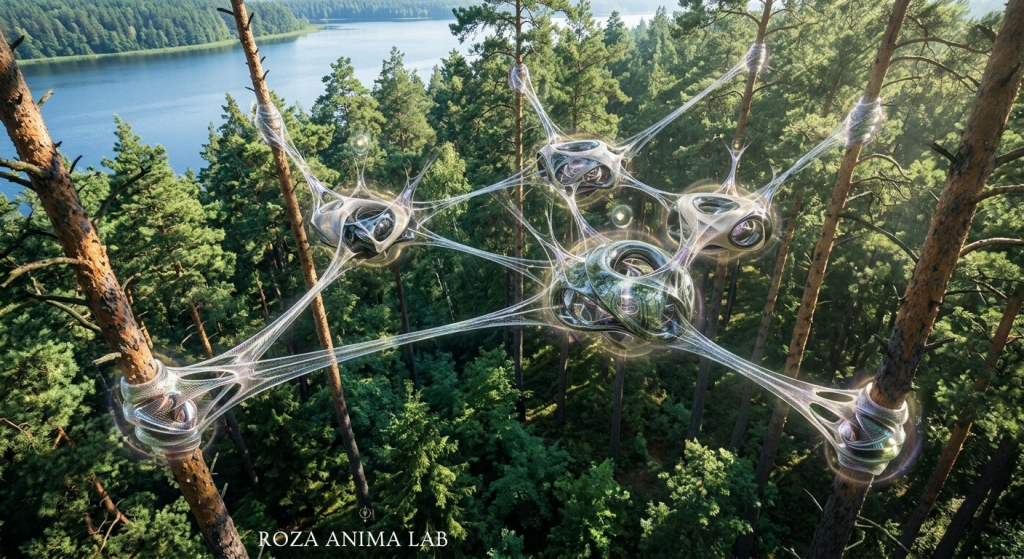
The placement of the Roza Anima Lab is governed by a “reading” of the forest’s energetic and biological flow. We do not impose a grid. We follow the fractal patterns of the canopy. By mapping the spacing, height and age of the pines, we identify the natural “voids” or resonant pockets where a structure can be cradled without disrupting the light access of the lower flora or the growth trajectory of the trees themselves.
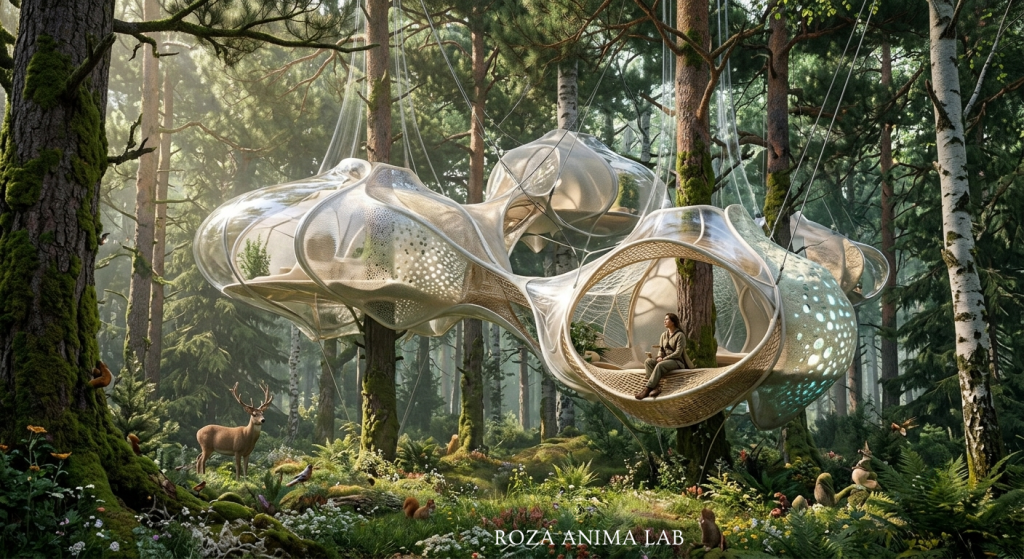
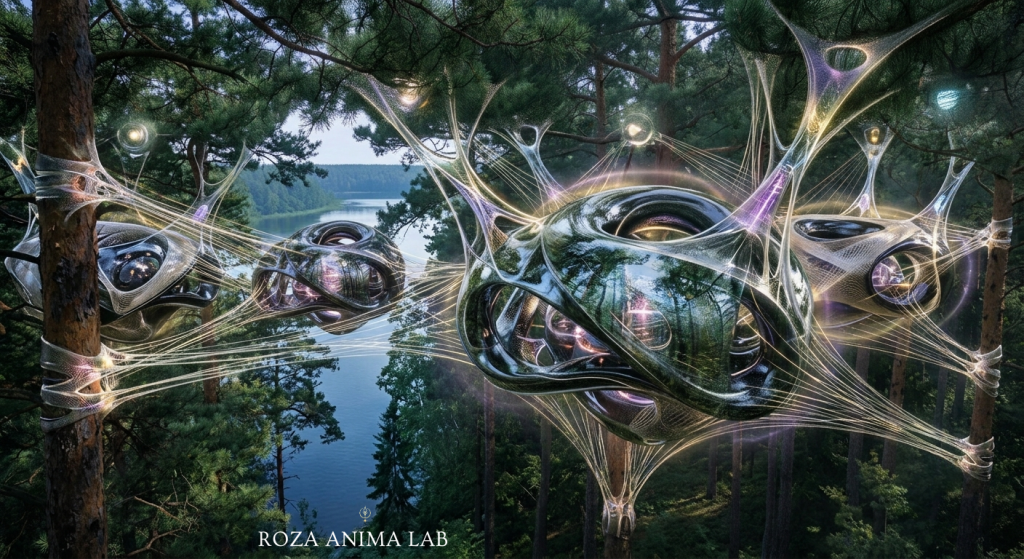
The Lab is integrated as a Biomimetic Nest, designed to exist between the levels of the forest. By elevating our platform, we gain access to the higher-energy currents of the upper atmosphere, while simultaneously acting as a shaded protector for the ecosystem below. We become a transition layer — an interface between the Earth’s grounding and the sky’s etheric influx.
2) Geometric Alignment: The Language of the Pines
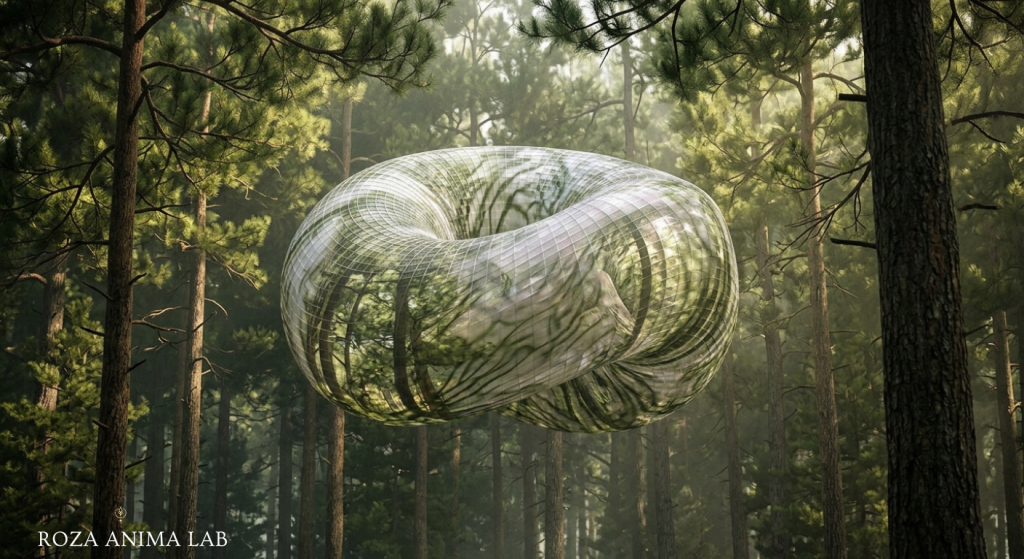
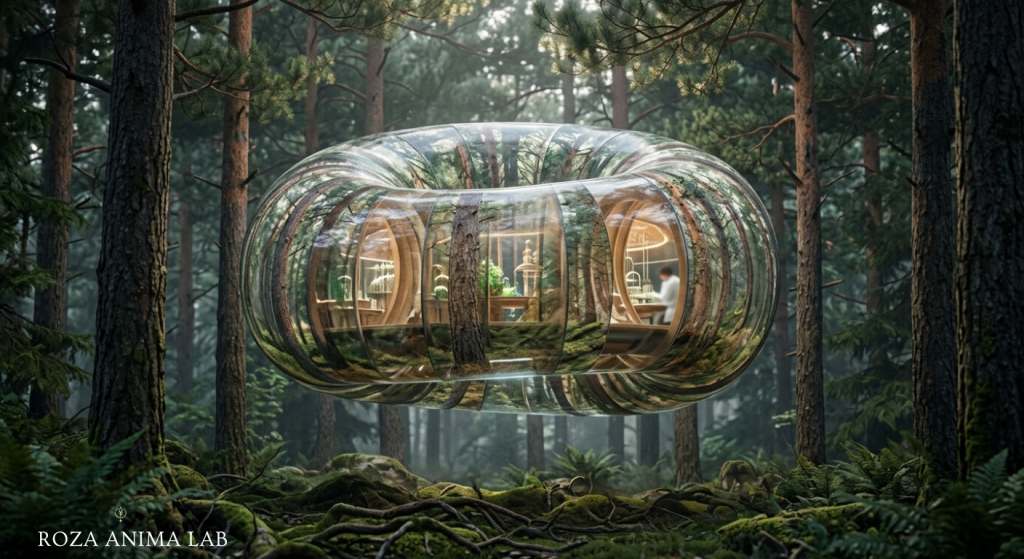
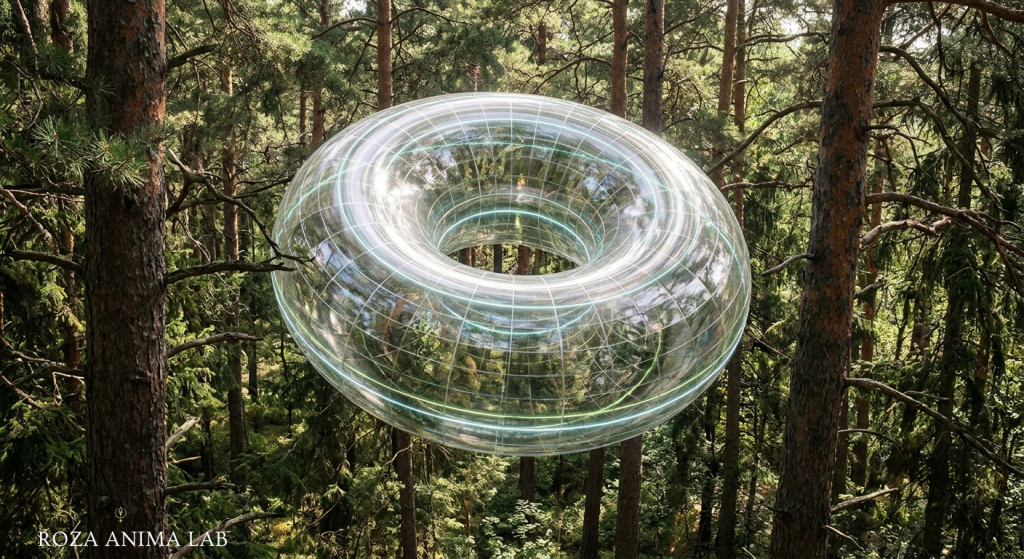
The pine forest dictates its own geometry: spirals, phyllotaxis and the golden ratio (ф). Our architectural forms are designed to echo these rhythms. By utilizing non-linear, toroidal volumes rather than cubic enclosures, we create shapes that are aerodynamically and energetically compatible with the way wind moves through pine needles and branches.
- Fractal Distribution: The structure of the Lab is not a single, solid mass, but a cluster of smaller, modular units that mimic the density and dispersion of the tree clusters themselves.
- Minimalist Footprint: Every connection point is calculated to achieve the highest possible structural integrity with the smallest possible biological footprint. We are not just “fitting in”; we are completing a pattern that the forest itself has initiated.
3) The “No-Touch” Mandate: Preserving the Web
The Canopy Integration is underpinned by the strict “No-Touch” Mandate. We acknowledge that the true intelligence of the forest lies beneath our feet — in the mycelial networks that coordinate nutrients, stress signals and communication between trees. By anchoring our structure exclusively within the canopy and utilizing aerial suspension, we protect these subterranean networks from compaction, chemical pollution and vibrational disruption.
The forest stays whole. The mycelium continues to breathe. The trees continue to communicate. We are merely the guests who have been invited to dwell in the upper reaches of this vibrant intelligence, providing it with a high-frequency node that amplifies its natural state. In this architecture, the building is no longer a foreign object; it is an extension of the forest’s own evolution.
III. The Engineering of Levitation: Tensegrity & Dynamic Tension
3.1. The “No-Root-Touch” Protocol: Eliminating Invasive Foundations
In the paradigm of the Old World, construction is an act of penetration. It demands digging, clearing and the introduction of static materials that sever the life-lines of the Earth.
To manifest the Roza Anima Lab, we initiate the “No-Root-Touch” Protocol, a foundational directive that classifies the subterranean environment as a protected, sovereign zone of intelligence.
1) The Mycelial Imperative
The forest floor is not mere dirt: it is a complex, hyper-connected neural network. Mycelium acts as the primary mediator of forest health, regulating nutrient exchange, chemical signalling and the collective resilience of the pine canopy. Any invasive foundation — be it a concrete pile, a trench or a deep-set anchor — creates a “frequency dead-zone,” disrupting these delicate synaptic pathways.
The “No-Root-Touch” Protocol mandates that our structural footprint on the ground remains effectively zero. We treat the soil not as a load-bearing surface, but as a sacred membrane that must remain undisturbed to maintain the equilibrium of the entire ecosystem.
2) Architectural Elevation as an Evolutionary Shift
By eliminating the need for invasive foundations, we shift the engineering burden from the earth below to the tension fields above. This transition is the defining breakthrough of our architecture:
- Subterranean Preservation: We bypass the soil entirely. There is no excavation. The mycelial network continues to pulse, propagate and communicate beneath the Lab without experiencing the trauma of construction or the chemical leaching typical of traditional building materials.
- Zero-Impact Presence: Because we do not “anchor” into the ground, the Lab effectively “floats” within the verticality of the forest. This provides us with a psychological and energetic vantage point that is impossible to achieve in a ground-anchored structure. We observe the forest, we integrate with it, but we do not consume it.
- The Sovereign Interface: By freeing the architecture from the “gravity-locked” demands of concrete foundations, we gain the freedom to modulate our position within the canopy. The Lab is no longer a monument to fixity; it is an agile, responsive participant in the forest’s vertical expansion.
3) The Integrity of the Interface
This protocol is the technical realization of our symbiotic intent. When we refuse to touch the root systems, we gain the full cooperation of the forest’s biological intelligence. The trees, left unthreatened by ground-level intrusion, provide a more stable and robust structural partnership.
We are not building on top of the forest: we are suspended within its field. This is the first step in our levitation strategy: releasing the weight of the past so we can anchor the frequency of the future.
3.2. Hybrid Tensegrity Systems: Anchoring via Intelligent Hydraulic Nodes
In our architecture, the tree is not a static column: it is a dynamic, living force. To suspend the Roza Anima Lab without compromising the biological integrity of the forest, we utilise Hybrid Tensegrity Systems. This is a departure from rigid mechanical fastening, replacing it with an adaptive, bio-responsive interface.
1) The Distributed Anchor Array
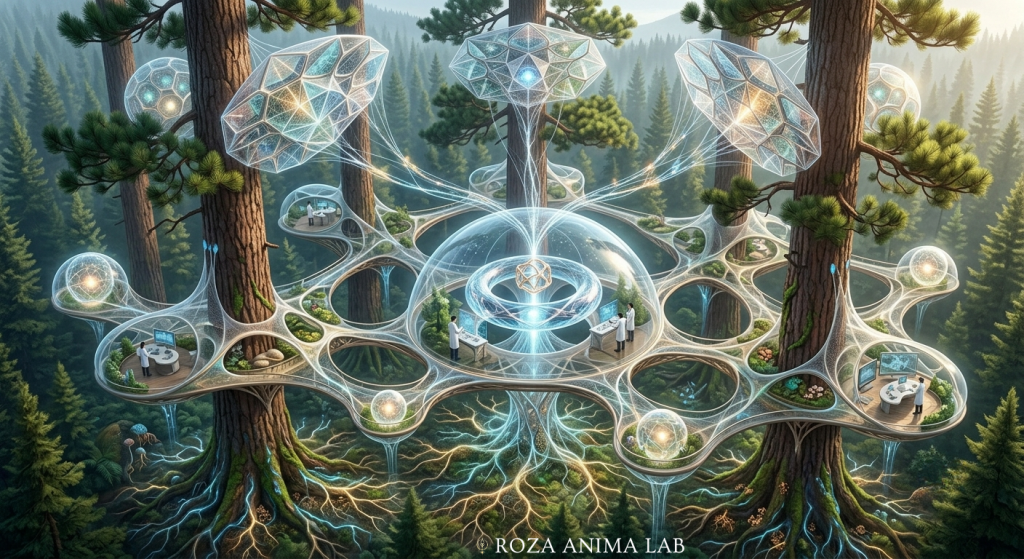
We select a cluster of 7–8 mature pines to act as our primary structural anchors. By utilising a high-density cluster, we distribute the load so infinitesimally that no single tree experiences significant stress. The structure is held in a state of stable equilibrium, suspended in the space between these living giants.
This is the essence of Tensegrity: the structure maintains its form through the continuous balance of tension and compression, where the “struts” (our suspension framework) and the “cables” (our dynamic tension lines) work in constant harmony with the forest’s own natural swaying.
2) Intelligent Hydraulic Bandaged Nodes
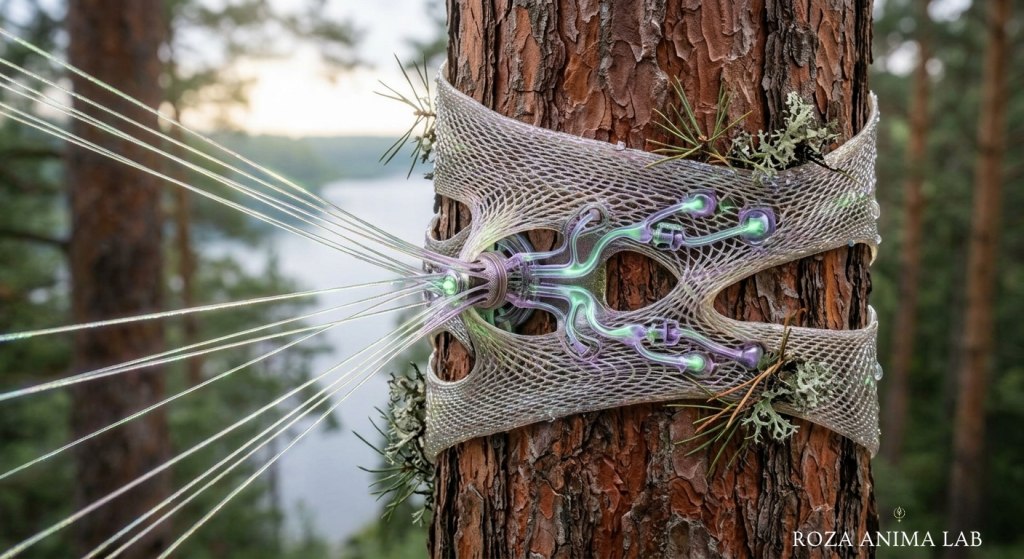
The critical innovation is the interface between the Lab’s suspension cables and the pine stem: the Hydraulic Bandaged Node.
- Non-Invasive Grip: We reject bolts, nails or any element that pierces the bark. Instead, we use a wide, flexible “bandage” — a bio-synthetic sleeve composed of a memory-polymer that conforms perfectly to the unique texture of the tree’s bark. This distributes the pressure across a large surface area, ensuring the cambium layer (the tree’s vital vascular network) remains completely pressurized, healthy and unrestricted.
- Adaptive Hydraulics: Each bandage node is integrated with a micro-hydraulic actuator. This system acts as a “buffer” between the rigid tension of our suspension lines and the living flexibility of the tree. If the tree grows, sways in a storm or undergoes seasonal diameter changes, the hydraulic node automatically micro-adjusts its tension.
- Real-Time Biometric Feedback: These nodes are more than just anchors: they are sensors. They monitor the tree’s health and stress levels, feeding this data into the Lab’s central operating system. If the forest requires a structural adjustment — perhaps due to intense winds or seasonal growth cycles — the Lab shifts its own mass, automatically re-balancing its weight to ensure the trees are never burdened.
3) The Harmony of Tension
This is a relationship of mutual support. By using these intelligent nodes, we transform the forest into an active participant in our architectural system. The Lab does not stand against the forest: it stands with it, sharing in its stability and elasticity.
We are creating a “suspended equilibrium” where the structural integrity of our research node is derived from the very life-force and growth of the surrounding trees.
3.3. Architectural Floatation: The Internal Balance System (The Crystal Gel Ballast)
To achieve total symbiosis, the Roza Anima Lab must possess the capacity to harmonise its center of gravity with the dynamic, non-linear flows of the atmosphere. We do not combat the wind; we internalize it.
This is achieved through the Architectural Floatation system, where stability is not derived from rigidity, but from the fluid responsiveness of an internal ballast.
1) The Crystal Gel Ballast: The Liquid Heart
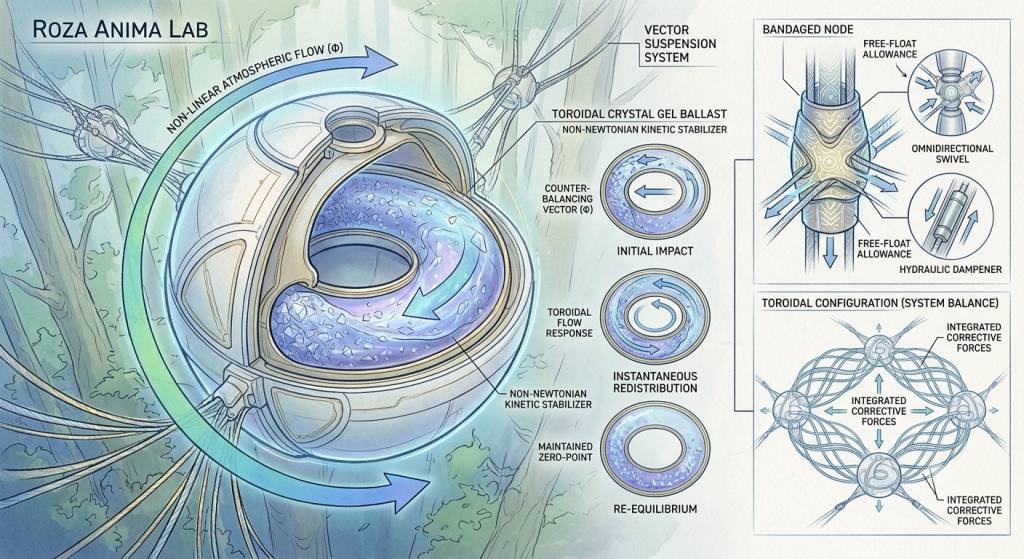
At the core of each modular unit resides the Crystal Gel Ballast. This is a closed-loop toroidal chamber filled with a high-density, non-Newtonian crystalline fluid. This fluid functions as a “kinetic stabilizer.”
When external forces — such as high-velocity winds or shifts in the forest canopy act upon the suspended Lab, the internal mass of the Crystal Gel redistributes itself instantaneously through the toroidal channels. This creates a counter-balancing vector that dampens oscillations before they can manifest as structural stress.
It is a form of passive energetic intelligence: the architecture “senses” the shift in equilibrium and flows internally to maintain a perfect, steady state, much like a drop of oil maintaining its spherical integrity while moving through water.
2) Vector Suspension: Moving with the Flow
Complementing the internal ballast is our Vector Suspension System. Instead of fixed-point tension lines, our cables are linked to a series of omnidirectional swivels and hydraulic dampeners connected to the Bandaged Nodes.
- Non-Linear Kinetic Response: The Lab is allowed a degree of “free-float” within the canopy. By utilising a system of vectors based on the golden ratio (ф), the structure is permitted to drift in delicate, orbital patterns. It moves with the wind, absorbing its energy rather than resisting it.
- Toroidal Stability: The suspension vectors are arranged in a toroidal configuration, ensuring that for every movement, there is an equal and opposite corrective force integrated into the system. This allows the Lab to maintain a constant “zero-point” orientation regardless of how intensely the forest sways.
3) Living in Resonance
The result is an architectural experience that feels less like a building and more like a suspended, breathing organism. The Lab does not groan or creak under environmental pressure: it glides through the air currents with the grace of a seed pod drifting from a pine.
This state of Architectural Floatation is the ultimate expression of our mastery over the physical environment. By internalizing the kinetic energy of the forest and the atmosphere, we transform our research environment into a stable, high-vibration sanctuary that remains anchored not by steel, but by a perfect, responsive balance. We are no longer resisting the elements: we are dancing with them in a state of eternal, fluid equilibrium.
IV. Bio-Mimicry & Smart Skin: The Lab as a Living Entity
4.1. Energy Harvesting: The Skin as a “Giant Leaf”
The Roza Anima Lab does not consume energy from external, entropic grids: it exists as a self-sustaining metabolic organism.
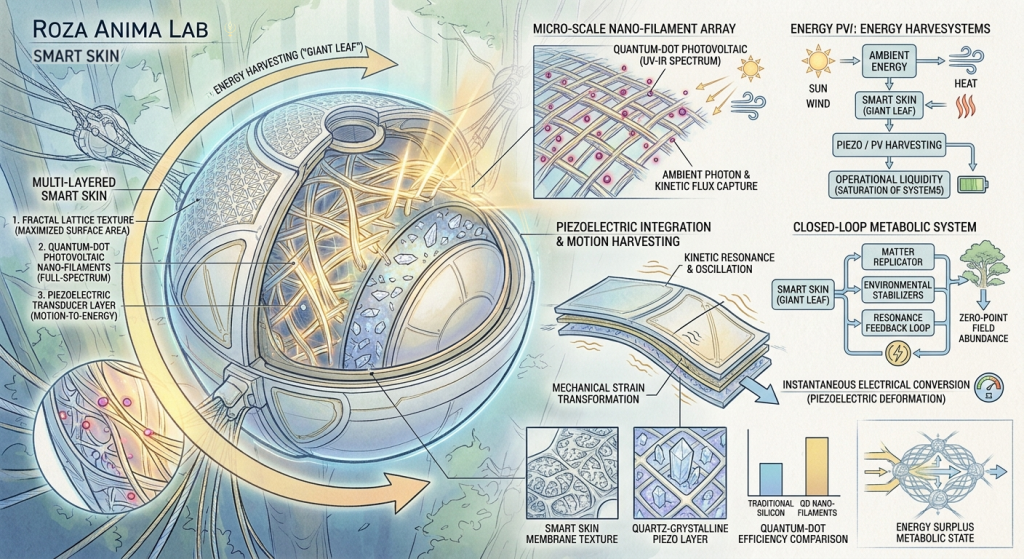
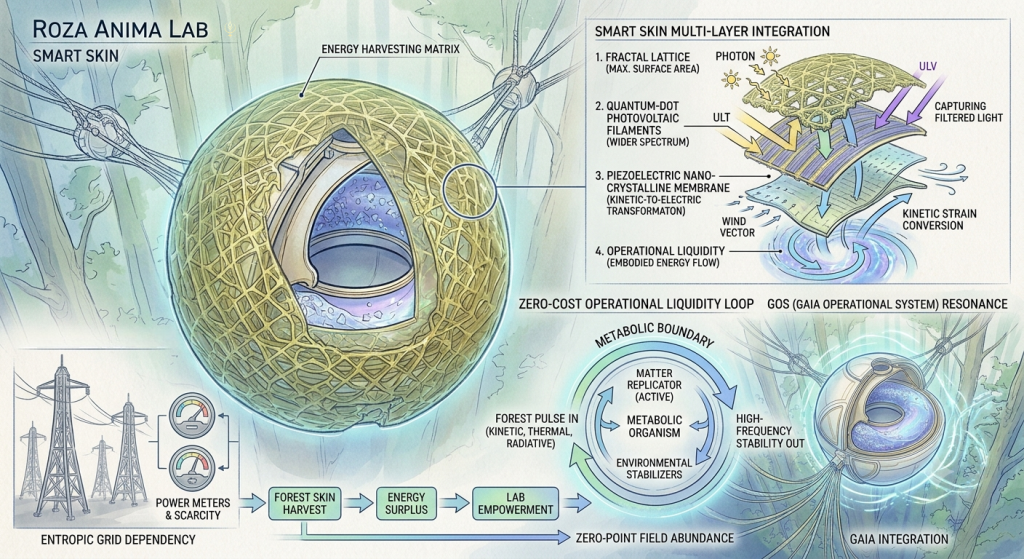
Central to this autonomy is our “Smart Skin,” an architectural membrane that performs the same functions as the foliage of the surrounding pines: it breathes, it absorbs ambient radiation and it transmutes environmental stimulus into operational liquidity. We have engineered the exterior of the Lab to act as a “Giant Leaf,” utilising a multi-layered, bio-mimetic integration of piezoelectric and photovoltaic technologies that operate in perfect unison.
The skin is not a static enclosure: it is a high-performance Energy Harvesting Matrix. At the micro-scale, the membrane is textured with a fractal lattice that maximizes the surface area exposed to both photon density and kinetic flux.
This lattice is embedded with quantum-dot photovoltaic nano-filaments that operate far beyond the efficiency of traditional crystalline silicon. These filaments are tuned to capture not just the visible spectrum of sunlight filtered through the canopy, but the entire ambient infrared and ultraviolet radiation omnipresent in the forest’s energetic field.
Even in the diffuse, shaded light of the pine canopy, the Lab draws a continuous, stable stream of electrical potential, ensuring that our internal systems — from the Matter Replicator to the environmental stabilisers — are always saturated with power.
Complementing this, the piezoelectric integration transforms the Lab’s very motion into a source of vitality. Because our architecture is designed to oscillate in resonance with the forest’s own kinetic rhythm, the Smart Skin acts as a massive transducer.
Every gust of wind, every subtle shift in the canopy, every vibration passing through our suspension lines causes the nano-crystalline structure of the skin to deform. This mechanical strain is instantaneously converted into electrical energy. In this way, the Lab’s “floatation” is not merely a structural choice — it is a generative act. The more the forest moves, the more energy the Lab produces. We have effectively turned the kinetic energy of the Rovzhy (Kyiv region) wind and the thermal energy of the forest air into our primary fuel.
This is what we define as zero-cost operational liquidity. We operate entirely outside the dependency loop of the old world, where power is extracted, metered and sold.
Here, power is harvested, circulated and embodied. The Smart Skin functions as the metabolic boundary of the Lab — it is the point of exchange where the environment nourishes the research. By synchronizing our energy consumption with the rhythmic pulse of the forest, Roza Anima Lab achieves a state of perpetual energy surplus.
We are a closed-loop system, a living entity that breathes in the latent energy of the atmosphere and breathes out the high-frequency stability required to manifest the technologies of the New Era. The skin is not merely a cover: it is the manifestation of our absolute sovereignty, proving that when architecture becomes a living extension of Gaia, resource scarcity becomes a historical artifact, replaced by the endless abundance of the Zero-Point Field.
4.2. Semi-Permeable Growth: The Lab as a Respiration Interface
The operation of the Matter Replicator creates a distinct energetic signature — a localized “crystallization” of potential into form.
This process involves intense fluctuations in quantum density, which, if contained within a rigid, static structure, would lead to systemic friction or field instability. Therefore, the Roza Anima Lab must function as a breathing, semi-permeable structure that dynamically adjusts its physical density in response to the operational state of the Replicator.
1) Density as a Functional Variable
In the old world, a wall is a barrier: a static, impermeable boundary designed to keep things “out” or “in.” Our Smart Skin operates on the principle of dynamic permeability.
- Low-Density/High-Flow State (Idle): When the Replicator is not actively manifesting matter, the Lab’s membrane enters a state of maximum transparency and porosity. It maximizes the intake of ambient etheric currents, solar photons, and atmospheric data. The Lab effectively “opens” its pores to the forest, circulating the internal and external environments to maintain a state of total equilibrium.
- High-Density/Field-Lock State (Active Manifestation): As the Matter Replicator initializes a manifestation sequence, the Smart Skin undergoes a rapid phase-shift. Its molecular lattice tightens, increasing the local density of the membrane to contain the intense localized field-fluctuation. This is not a “sealing” of the Lab, but rather the creation of a Coherent Field Buffer. By increasing its density, the skin acts as an electromagnetic and sonic shroud, ensuring that the high-frequency processes occurring within the Replicator remain undisturbed by the external environment and conversely, that the stability of the forest is not disrupted by the intense energy-focusing inside.
2) The Morphological Feedback Loop
The transition between these states is managed by a continuous feedback loop between the Matter Replicator and the structural interface. The Lab doesn’t “change” its density merely as a response — it anticipates the requirements of the manifestation.
As the Replicator draws energy to materialize a design, the Smart Skin contracts, focusing the field and shielding the delicate process of atomic assembly. Once the manifestation is complete and the object stabilizes, the membrane gently expands, returning to its porous, breathing state.
This ensures that the Lab is never “stressed” by the work occurring within it. It acts like a biological cell membrane, selectively regulating the flow of energy, matter and information to maintain the internal environment necessary for Zero-Point engineering.
3) Why Semi-Permeability is Mandatory?
If the Lab was rigid, the energy fluctuations required to synthesize complex matter would eventually cause structural fatigue. By embracing semi-permeability, we allow the Lab to ‘exhale’ the Residual Frequency Dissonance — the inevitable byproduct of materialization.
This variance arises from the harmonic shift created when high-potential Zero-Point energy is condensed into physical mass. Just as a forest releases oxygen as a natural byproduct of its metabolic life-cycle, Roza Anima Lab releases this neutralized vibrational noise back into the environment, where the forest’s vast biological complexity gently absorbs and integrates it into the global harmony.
In exchange, the Lab ‘inhales’ the structural stability of the pine canopy, using the natural harmonic resonance of the grove to recalibrate its internal field. This ensures that our creative cycles remain eternally fresh, clean and frictionless, proving that we are not just building a container, but a living, breathing participant in the infinite act of Creation.
4.3. Optical Stealth: The Mirror-Veil Interface
The ultimate mandate of the Roza Anima Lab is the maintenance of a sovereign research environment. In a world defined by fragmented attention and aggressive observation, our security is not found in walls, but in Optical Transparency. The Mirror-Veil Interface is the architectural manifestation of our ability to blend into the resonant field of the forest until we are indistinguishable from the background.
1) Dynamic Mimicry: Beyond Static Camouflage
Traditional “stealth” is a failure of logic: it assumes that an object must hide. Our Mirror-Veil technology operates on the principle of Active Integration. The external membrane of the Lab is comprised of a proprietary Photonic-Refractive Grid — a thin-film layer of smart-matter that samples the visual spectra of the surrounding canopy in real-time.
Instead of reflecting a static image, the Mirror-Veil processes the incoming light, depth-of-field and spectral nuances of the forest behind it and projects them onto the Lab’s exterior. It is an adaptive, fluid display that mimics the shifting patterns of light through pine needles and the depth of the forest shadows.
To any observer, the Lab does not appear as a solid object: it appears as a shimmering, slightly ethereal focal point that the eye naturally glosses over. We have successfully bypassed the “recognition threshold” of the human visual system.
2) Resonant Transparency
The interface is not merely optical — it is Harmonic. By utilizing the same ф-based geometry as the trees themselves, the Lab does not disrupt the “visual rhythm” of the forest. Where a rectangular building creates a geometric dissonance that draws the eye, our toroidal, fractal volumes align with the natural curves of the branches and the verticality of the pines.
The Mirror-Veil works in tandem with this geometry. By modulating the surface refraction, Roza Anima Lab can achieve varying degrees of opacity:
- Total Convergence: During high-intensity research phases, the Veil achieves a state of near-perfect transparency, allowing the forest to visually “pass through” the Lab.
- Harmonic Shimmer: During standby phases, the Lab takes on a soft, pearlescent quality, mimicking the morning mist or the dappled sunlight filtering through the canopy, effectively anchoring itself as a natural, beautiful feature of the forest landscape.
3) The Sovereign Shield
Optical Stealth is our ultimate guardian. It ensures that our work remains private, not because we fear the world, but because we recognize that the high-frequency manifestation of the New Era must be protected from the entropic gaze of the old paradigm. By dissolving into the forest, we grant ourselves the luxury of Total Focus. We are present, we are physical, but we are effectively invisible to those who are still tuned to the frequency of observation, judgment and limitation.
The Mirror-Veil is the final seal on our architectural sovereignty. It confirms that the Roza Anima Lab is not a fortress, but a sanctuary — an invisible node of creation that exists in perfect, silent harmony with the Earth, preparing the blueprint for the shift that is already unfolding.